Hey there, it’s your coach Jordan Briones.
I’ve been coaching Jamie for a little while now, and the other day we talked about something that I think holds back a lot of players, especially in mixed doubles. It’s a shot that creates instant offense, puts massive pressure on your opponents, and frankly, once you learn to recognize the setup, it becomes one of the easiest ways to end a point.
I’m talking about the Ernie.
Jamie has been playing for a little over a year now. All the skills are there. The dinks are solid. The rolls are really good. But like so many intermediate and advanced players, the Ernie just never clicked. He’s seen friends do it well, but he never developed the skill himself.
And honestly, that’s the story for most players. They don’t know when to look for it. They don’t know how to move there. They never really tried it because it felt too complicated or risky.
But here’s the reality. If you’re already hitting good penetrating dinks and you understand positioning, you are closer to executing the Ernie than you think.
How to Master the Ernie and Put Pressure on Your Opponents
Spot the Right Setup for the Ernie
The first thing you need to understand is where you’re putting the ball to create the opportunity.
In a mixed doubles scenario, especially when the guy is crowding the middle, you want to be hitting deep to his backhand side. If you’re rolling the ball crosscourt and you’re getting your opponent stretching or half falling or short hopping, that’s when the door opens.
Anytime the ball is behind them, or if they’re on a stretch or a reach, it becomes very hard for them to get back to the middle. And that’s your window.
You’re probably already hitting this shot all the time. That’s why I tell players like Jamie that they could just jump opponents if they started recognizing these moments. The setup is happening naturally. You just have to see it and commit.
Your Dink Can Make or Break This Move
Here’s something critical that a lot of players miss. You’re probably not going to earn an Ernie if your dink is short and sitting up around the kitchen line.
The most effective Ernie setups happen when your dink is past the line and forcing your opponent into an uncomfortable position. When they’re stretching, when the ball is bouncing behind them, when they can’t take it out of the air cleanly, that’s when you should be moving.
The pattern that works best is when you hit your forehand roll and you look like you’re going to speed it up or roll it crosscourt, but then you change direction and send it down the line.
That’s the one where I see the most success. Especially if your mixed partner is holding the line on the other side, sometimes it’s just one dink from them and you don’t even need to set it up at all.
It’s all about the read.
Trust What You See and Move Confidently
Most of the time, if your opponent is not taking that ball out of the air, you’re going to have an opportunity. And even when you’re dinking and you’re already one or two feet off the line, you have room to step in and make the play.
You already know when the ball is going to be behind them. You can see it happening. The key is trusting what you see and committing to the movement.
One thing to keep in mind is how far your opponent is from the ball. You don’t want to put it too deep to where they’re able to flick it or ball it out of the air. You have to gauge their ability to get back and defend. But as long as you keep it down and penetrating, you’re going to create pressure.
The only real option your opponent has besides resetting the ball is to try to hit you. And if they’re stretched out and off balance, their highest percentage shot is going back to the middle anyway. So you’re putting them in a tough spot either way.
Step Right, Jump Right, and Nail the Timing
The footwork for the Ernie is simpler than most people think.
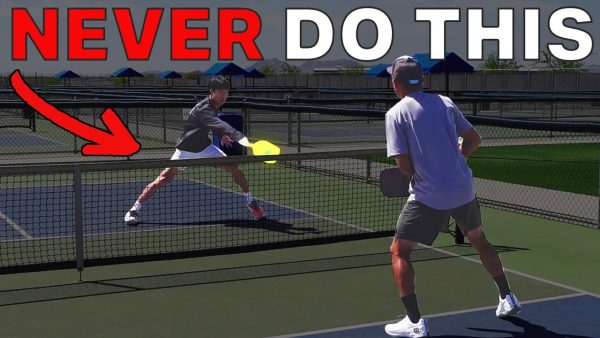
You’re stepping with your left foot first, then crossing over, and then jumping with your right foot landing outside the sideline. You don’t need to make it a huge leap. You’re taking the ball right at the edge of the court. You just need to make sure your right foot lands outside that line.
The timing is what separates a good Ernie from a great one.
A lot of players leave too early and get there way ahead of the ball. When that happens, you end up jammed and cramped, and it becomes harder to control your placement. Instead, you want to hit your topspin dink, pause for just a moment, and then move really fast.
The best timing is to start your jump right after the ball bounces on the other side, or even right at contact when you hit your roll. The later you can leave, the harder it is for your opponent to read what you’re doing. And if the ball is really deep and forcing them back, you can leave even later because there’s no way they can recover back to the middle.
Ernie Placement – Place It Smart and Choose One Hand or Two
Placement is everything on the Ernie.
The worst place you can hit it is right back at the person who just hit the ball because they can defend it. You want to aim for their feet, or you want to go outside to their right foot or even further out. Their partner is going to be covering the middle, so you’re targeting the open space or their body.
If you’re hitting it down the line, that’s going to be way easier. But the best case scenario is hitting it to the opponent’s right foot or just outside of it. You need to be a little bit ahead of the ball and come in with a slight inside out angle.
And here’s the other thing. You don’t need to make it a huge swing. You can just pop it. A quick compact punch is often more effective than trying to crush it, especially if you’re early and in good position.
You can hit the Ernie with one hand or two hands depending on the situation.
The one handed Ernie is going to be more explosive and you can leave later because you’re jumping and reaching further out. The two handed version gives you more control and stability, but you lose a bit of range.
If the ball is deeper and you need more space, go one handed. If the ball is closer and you want to be more precise with placement, two hands can work. It really comes down to the setup and how comfortable you are with each option.
One final piece that most players forget. After you hit the Ernie, you need to be ready for the cleanup.
If the ball comes back, you stay right there and hit it again. Your partner should be ready with their forehand on the other side. Most of the time, if your Ernie is going down, the ball has to come back up. That means you’re in perfect position to put it away on the next touch.
Don’t hit the Ernie and then back off. Stay aggressive. Stay ready. Finish the point.
Final Thoughts – Why You Should Stop Thinking of It as a Trick Shot
The Ernie is not some trick shot reserved for pros. It’s a strategic offensive play that you’re probably already setting up without realizing it.
Once you start recognizing when your opponent is stretched, when the ball is behind them, when they can’t take it out of the air, you’ll see these opportunities everywhere. And once you commit to the footwork and timing, you’ll start putting away balls that used to just sit there waiting to be attacked.
Jamie went from never attempting the Ernie to recognizing the setup and executing it consistently in one session. That’s how accessible this shot really is when you understand the mechanics and the read.
Give it a try. Look for the stretch. Commit to the movement. And watch how much pressure it puts on your opponents.
See you on the courts,
Coach Jordan Briones