Hey there, it’s your coach Jordan Briones.
There are lots of things that have completely changed this game over the years. The serve has evolved. Paddle technology keeps pushing boundaries. But one of the things that has completely taken the pro game by storm is the two-handed backhand.
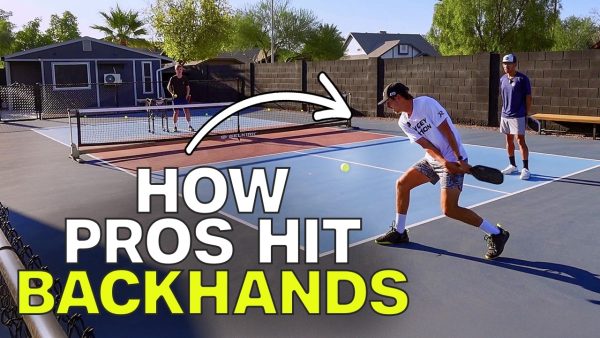
And I’m not just talking about the soft reset dink anymore. I’m talking about the two-handed topspin backhand that players are using to attack, control rallies, and keep opponents guessing.
If you’ve been wanting to learn how to hit this shot offensively and consistently, this is exactly what we’re going to break down today. Because once you understand why it’s so effective and how to execute it properly, you can start using it at any level.
How to Hit an Offensive Two-Handed Backhand Consistently
Position Yourself Right: Wide Stance and Low to the Ball
Before you can generate real topspin on this shot, you need to understand your positioning.
You want to be in a really wide stance. This gives you the ability to move and adjust quickly because you are hitting this ball off the bounce. Most of the time, you’re going to use a variation of the shuffle step to position yourself.
If you need to move left, you shuffle left. If the dink is deeper and more penetrating, you create space by coming back off the line. A lot of times when I hit my topspin dinks, my feet are positioned at about a 45 degree angle.
Here’s the critical part that most players miss. You have to get really low.
What I’m trying to do is get both of my wrists underneath the contact point of the ball. If the ball contact is up here, I really need to drop my positioning low enough so that my wrists are below the ball. That’s what allows me to brush up and create spin.
If you stay too upright, you’ll never generate the friction needed to load the ball with rotation.
Keep the Ball in Front of You to Hit Clean Topspin
Where you make contact with the ball determines whether this shot works or not.
As I set up, my paddle usually sits somewhere around my left hip. When I contact the ball, I want to keep it relatively in front of me. I’m hitting it somewhere in this zone closer to my right knee.
I do not want to let this ball get behind me. If the ball gets behind my body, it becomes extremely difficult to hit topspin and create the kind of shape I’m looking for. I have to position myself so the ball stays in front where I can swing up on it comfortably.
This is where footwork and preparation come together. If you’re not in the right position, you won’t make clean contact. And if you don’t make clean contact, you won’t generate spin.
Focus on a Controlled Swing to Keep the Ball in Play
The swing path for this shot needs to be vertical, but it also needs to be controlled.
Ben Johns has been working on his two-handed topspin dink, and one thing you’ll notice is that he’s not swinging super fast. He’s actually swinging at a slow to medium pace.
What we’re trying to accomplish here is simple. Get topspin and get the ball to bounce on the other side. You don’t need to crush it. You need to brush it.
That slower, more deliberate swing gives you time to feel the ball roll across your paddle face. It gives you control. And it keeps the ball from popping up or floating long.
Speed comes later once you have the mechanics dialed in.
Align Your Feet and Lift Through the Shot for a Baseline Topspin Drop
A lot of the same principles apply when you’re hitting the two-handed topspin drop from the baseline.
First, make sure your feet are in line with your target. If I’m trying to hit a ball crosscourt, I draw an imaginary line from where the ball bounces to my target. I want both of my feet on that line so my full body and drive are going toward the target.
Second, my paddle preparation stays the same. I’m getting my wrists below the ball so I can extend up and through the shot.
The main difference between the dink and the drop is the swing length. When I hit my drop, it’s a more elongated and longer swing. My paddle tends to finish higher and more upward rather than across my body like it does on dinks.
On dinks, I usually finish right around my right shoulder. On drops, I’m finishing higher and exaggerating that lift a little bit more. That extra lift is what gives the ball enough arc to clear the net and still dip down into the kitchen.
Know When to Hold Back and Stick to High-Percentage Shots
There are a few situations where I will not attempt the two-handed topspin backhand.
The first is when the return is hit really hard and it’s penetrating deep into the court. If I’m not balanced and I can’t find the apex of the shot, I’m not going to force it. The apex is the slowest part of the ball’s flight path. It’s that moment when the ball pauses right before it starts to fall. That’s when I want to make contact.
If the return is hit really hard and deep, I’ll usually go with a one-handed slice to buy myself more time and get back into position.
The second situation is when I’m simply not balanced. If the return is really deep or really short and I have to run to get the ball, sometimes that forces me to cross step. When I cross step on the backhand side and try to use a two-hander, it goes against my natural motion. It twists me up and makes the shot much more difficult than it needs to be.
In those moments, I reset with what I know will work instead of forcing a low percentage shot.
Why Two-Handed Backhand Shot Changes Everything
The biggest reason the two-handed topspin backhand is so powerful is the options it gives you.
When you’re in position to hit this shot, you’re not locked into one outcome. You can roll and attack it with topspin. You can speed it up from the same exact position. You can keep it soft and controlled. That unpredictability is something you simply cannot create when you’re just hitting an open paddle face slice or a push dink.
Your opponent has to respect every possibility. And that hesitation is what gives you control of the point.
This is why we’re seeing this shot more and more in the pro game. It’s not a trend. It’s becoming a requirement.
Final Thoughts
This shot is not reserved for pros. It’s a weapon you can add to your game right now if you’re willing to put in the focused practice.
Start with your footwork and balance. Get low and make sure your wrists are below the ball. Keep your contact point in front of your body. Swing slow to medium with a vertical path. And know when to use it and when to choose something safer.
Once you start feeling that ball roll across your paddle and watching it dip with heavy rotation, you’ll understand why this shot is taking over the game.
It gives you control. It gives you options. And it makes you dangerous.
See you on the courts,
Coach Jordan Briones