Hey there, it’s your coach Jordan Briones.
I want to talk about something that most players completely overlook. Not their dink. Not their third shot drop. Their serve.
I know, I know. A lot of people think the serve in pickleball is just a way to start the point. Get it in, keep it legal, move on. But here is the thing. A powerful and accurate serve can put your opponent in a really bad position right from the jump. It can create short returns, forced errors, and free third shots that make the rest of the rally a whole lot easier for you.
I recently worked with my friend Brooks, who has one of the fastest serves I have ever seen pound for pound. And trust me, he is not some giant guy with a huge arm. He just knows exactly what to do with his body.
Let me break down what he does and how you can apply it to your own game.
How to Make Your Serve a Weapon, Not Just a Formality
Get Power From Your Legs, Not Just Your Arm
The number one thing Brooks focuses on before anything else is his legs.
Now before you roll your eyes and say you already know this, let me ask you something. When you step up to serve, are you actually getting low and loading your legs? Or are you standing straight up and just hitting the ball with your arm?
Because I see it all the time. Players walk up, stand tall, and just swing. That arm-only serve might be consistent, but it is leaving so much power on the table.
What Brooks does is get low and feel that tension in his legs before he even starts his swing. Think of it like igniting a switch. Once those legs fire, everything else has energy behind it. The hips, the shoulders, the arm — it all flows.
He also steps into his serve, which takes it one step further. That forward momentum into the court adds a little extra pop and forces opponents to deal with a serve that has more pace coming at them. It sounds simple, but the difference in how it feels and how it lands is night and day.
Use Your Hips to Guide the Ball
Once your legs are loaded, the next thing to think about is clearing your hips.
Here is what that actually means. Instead of just bringing your front hip forward toward your target, you are clearing that front hip out of the way and driving your back hip through toward where you want the ball to go. By the time you make contact, your hips should be almost fully open and facing your target.
A good cue for this is your belly button or your navel. If someone is standing behind you as you serve and they can see your navel pointing A good cue for this is your belly button or your navel. If someone is standing behind you as you serve and they can see your navel pointing right at your target, you are doing it right. That rotation is what allows your shoulders to open up, your chest to follow, and your arm to whip through with real speed.
Without the hip rotation, you are serving with just your arm. And a solo arm serve has a ceiling. There is only so much you can do with it before it becomes inconsistent or causes strain.
The third piece Brooks emphasized is the follow through. And this one ties everything together.
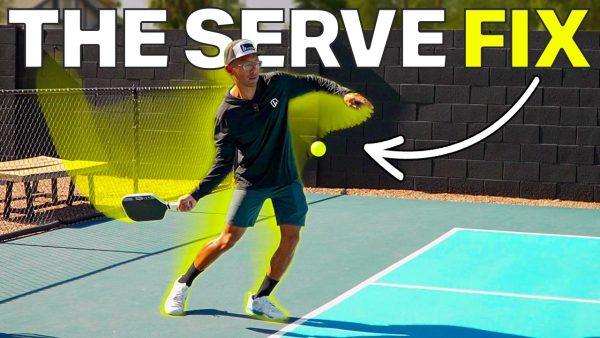
A lot of players hit the ball and stop. Their paddle kind of stalls out right at contact. What you want is for your arm to continue naturally over your shoulder after you make contact. Let the momentum carry it. That follow through is not just a finish position — it is actually what gives the ball that extra forward drive and helps you generate topspin on the serve.
Think of it this way. Your hips rotate, your shoulders open, your arm lags slightly behind, and then it whips through and finishes high and over that front shoulder. That sequence is what a fast, heavy serve looks and feels like.
Relax Your Grip to Unlock Maximum Power
Here is something that surprised me when I first started really paying attention to it.
Brooks’s grip pressure on his serve? About a four out of ten.
That is really light for someone hitting such a powerful ball. And that is exactly the point.
When players try to muscle the serve, they grip tight, their arm tenses up, and suddenly the natural whipping motion of the swing gets locked down. The wrist cannot come over the ball properly. The drop and the snap are gone. The serve actually ends up weaker and more inconsistent than if the player had just stayed relaxed.
Relaxation is not a soft thing. It is a power thing. The more relaxed your grip and your arm are, the more your wrist can naturally snap through the ball and create that spin and pace.
Next time you serve, check yourself. Are you white-knuckling that paddle? Loosen up. Let the mechanics do the work.
Now once you have the mechanics dialed in, the next layer is strategy. Because a powerful serve without a plan is just a fast ball that goes somewhere.
Brooks’s default target is the backhand. Most players have a weaker backhand return, especially under pressure, so starting there makes a lot of sense. But the real key is reading when your opponent has adjusted.
Once they start expecting it on the backhand, you switch it up. Go to the forehand. Go right at the body. A body serve with a lot of pace is one of the most underused and effective serves in the game because there is just not enough time to move out of the way. It jams people and leads to weak floaty returns that you can attack all day.
Keep them guessing and keep them uncomfortable. That is how your serve becomes a real weapon instead of just a way to start the rally.
Final Thoughts
To put it all together, here is what you are working toward. Load your legs and step in to build momentum. Clear your hips all the way through your target. Let your arm follow through high and naturally. Keep your grip and your arm relaxed so the snap can happen. And then aim with intention — backhand, forehand, or body — based on what your opponent is giving you.
None of these things are complicated. But when they all click together, your serve stops being something you just get in play and starts being something your opponents have to worry about every single time.
Go work on it. You might surprise yourself with how fast things change.
See you on the courts,
Coach Jordan Briones