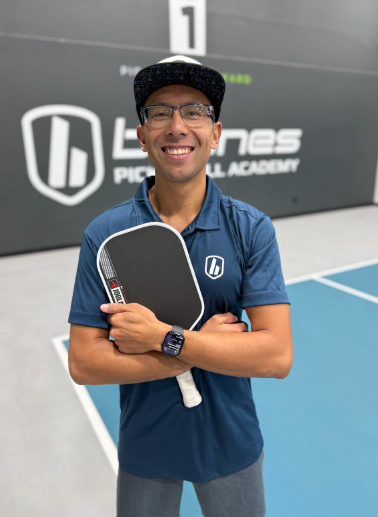
Hey there, it’s your coach Jordan Briones.
I’ve coached thousands of players over the years — from complete beginners at the 3.0 level all the way up to the pros. And after all of that time on the court, I’ve seen the same mistakes show up again and again at every level.
So today I want to share the most impactful tips I’ve collected over a decade of coaching. These aren’t random tricks. Every single one of these has helped real players improve quickly, and they’ll do the same for you.
Let’s get into it.
Most Impactful Pickleball Tips I’ve Learned from Coaching Thousands of Players
Fix Your Ready Position to Stop Hurting Your Counters
Here’s one of the biggest myths I see floating around in pickleball instruction. A lot of players believe that the ready position should have the paddle way out in front — extended, arms reaching, trying to meet the ball early.
Watch any pro. That’s not what you’ll see.
The best players in the world set up with a relaxed, neutral position. Elbow slightly bent. Paddle closer to the body than most people think. Grip right near the belly button area.
Why? Because from that position, you can push out and punch the ball with real force. If your arm is already fully extended, you have to actually bring it back before you can push forward — and that extra motion costs you time you don’t have in a fast exchange.
Relax your arms. Keep the paddle close. Push out on the ball from there and you’ll be surprised how much cleaner and more powerful your counters become.
Build Forward Momentum into Your Return to Reach the Net Strong
Here’s something most players never think about on their return — momentum.
If you hit your return and then start gathering yourself to move forward, you’ve already put yourself behind. By the time you’ve collected your weight and started closing, your opponent has hit their third and you’re stuck in no man’s land.
The fix is to build your momentum into the return itself. You want to be moving forward as you make contact so that your forward energy carries you toward the non-volley zone right after you hit. The ball goes one way, your body goes the other — and you arrive at the kitchen in a strong, ready position instead of scrambling to get there.
This matters even more when your opponent is serving big and likes to drive the third. The faster things are happening, the more you need that head start.
Use Third Shot Drive to Set Up Your Fifth, Not to Win the Point
This one changes the whole way you think about the third shot drive, and I see players get this wrong constantly.
The drive is not meant to be a winner. It’s not meant to paint the line. It’s a setup shot — specifically, it’s designed to create a better fifth shot opportunity.
When you’re driving the third, the goal is to keep it low enough over the net that your opponent is dealing with a tough ball, not picking you apart. You don’t need to blast it. You need to get it in at the right height so they have to hit up on it or handle a difficult contact, and then you can follow up with a quality drop on your fifth.
High percentage pickleball means giving yourself another shot, not gambling on one. Keep the drive controlled and use it as the first step of your transition, not the finish line.
Control Your Contact Point with Smarter Footwork
Footwork comes up in every coaching session I run, but there’s one specific thing I want to highlight here because it doesn’t get enough attention.
When you’re moving to the ball — whether to your forehand or backhand side — you need to lead with your inside foot, not your outside foot.
If you lead with your outside foot when moving right, you end up stretched out and reaching. Your contact point ends up behind you or off to the side, and you lose control of where the ball goes. Same problem on the backhand side.
But when you slide your inside foot in first and then create space with the outside foot, you arrive at the ball with room to get the contact point out in front of your body — which is exactly where it needs to be for a consistent, controlled shot.
Watch the top players. Every single one of them uses this inside-foot-first shuffle when they need to really move to the ball. It’s not complicated. It just requires awareness and practice.
Open Your Paddle Face and Push Out to Stop Hitting Volleys Into the Net
If you’ve been hitting fast-paced balls into the net at the kitchen, there’s a very good chance it’s a paddle face issue.
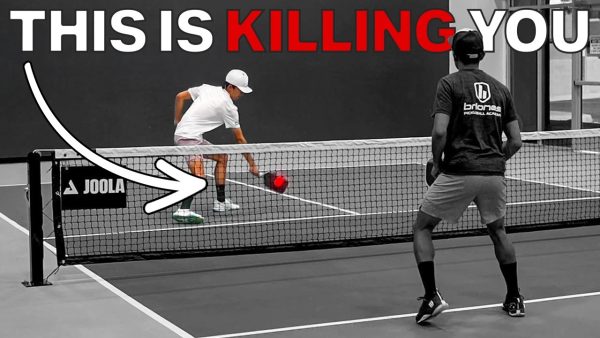
The instinct when a hard ball comes at you is to swing slightly downward or keep the paddle face closed. And that’s exactly what sends the ball into the tape.
What you actually need is a slightly open paddle face and a push that travels in a horizontal direction — not down. Push out. Not down. Your trajectory at contact should be relatively level, and the open paddle face naturally lifts the ball just enough to clear the net with depth.
Once you feel the difference between pushing out versus swinging down, it’s one of those things you can’t unfeel. Practice it deliberately and this error will almost disappear from your game.
Get Low and Go Backhand When You’re on Defense
This one applies specifically when you’re scrambling, when you’ve hit a ball a little high, or when your opponent has you in a tough spot.
Most players instinctively reach for their forehand in those moments. And that’s usually a mistake.
When the ball is coming fast and you’re in a defensive position, the backhand — whether one-handed or two-handed — gives you a much better platform to stabilize and block. You can cover a wider range of your body, you can add a second hand for extra stability if needed, and you’re much less likely to pop the ball up into a makeable position for your opponent.
Get low. Get to your backhand. Block it with intention. It keeps you in the point far more reliably than reaching around for a forehand that leaves you exposed.
Attack the Dominant Side First to Create Weak Counters
Whether you’re initiating an attack or firing off a counter, there’s one target you should go to first with almost every player you’ve never faced before: their dominant side.
Here’s why. The dominant side creates the chicken wing. When the ball comes at that right hip or right shoulder on a right-handed player, the elbow flares out awkwardly, the paddle face opens up, and the counter almost always goes somewhere weak — often right back at you or toward your forehand side.
Test it early. Watch how they react. Once they start adjusting, you open up your options. But the dominant side is your first read on any new opponent, and it pays off more often than not.
Communicate and Commit to the Middle in Doubles
Here’s a situation that costs doubles teams points all the time: a ball comes screaming through the middle and both players either freeze or both go for it.
The rule is simple. When you are the crosscourt player — when you hit the ball out wide to your opponent — you are responsible for the middle. Your partner is covering the line. You need to shift toward the center and sit on that fast middle ball.
It’s your backhand a lot of the time in that position. That’s fine. It’s still your responsibility. Get close to the center line, stay in an aggressive ready position, and be prepared to close that middle option before it becomes a free point for your opponent.
Use a Gentle Lift to Keep Your Resets Low and Unattackable
A lot of players reset the ball in transition by punching it — a horizontal motion, like a counter volley. And then they wonder why the ball keeps coming back higher and higher on the next shot.
A punch motion sends the ball forward and flat. It does not produce the soft, dipping trajectory you need for a reset to land in the non-volley zone and stay low.
What actually works is a lifting motion. Paddle face open, grip pressure light, shoulder leading upward — a very minimal lift that floats the ball softly into the kitchen. The energy goes up slightly, not out. The ball lands gently, loses pace, and stays low.
It feels counterintuitive at first because the ball is coming at you fast and the instinct is to push back hard. Fight that instinct. Get low, open the paddle, and lift. That’s what a real reset looks and feels like.
Add Power to Your Serve by Driving Your Weight Forward
This one is easy to implement and gives you immediate results.
Most players serve with no forward momentum. They swing, the ball goes, and they stay planted right where they are. That means all the power has to come from the arm alone, which has a ceiling.
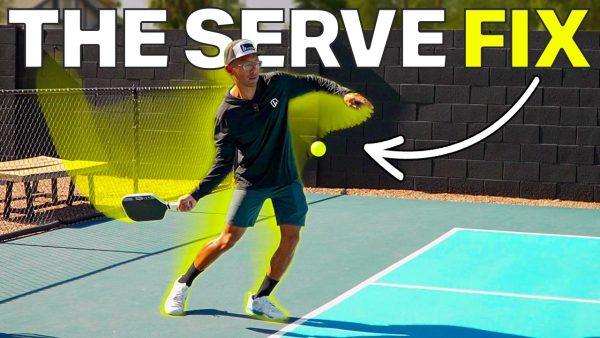
The best servers in the game — take a look at how the top pros do it — finish inside the court. Their weight is moving forward toward the target as they make contact, and they actually step in after the serve.
You don’t have to change your service motion to do this. Just make sure your weight is transferring forward as you swing and allow yourself to finish a step inside the baseline. The difference in pace and depth is real, and it takes almost no adjustment to implement.
Just make sure you back up and prepare for a deep return right after. Don’t get caught standing inside the court when a heavy ball is coming back at you.
Practice Your Returns for Just 10 Minutes a Day to Win More Points
I’m going to guess that you return serves in warmup and in games, but you’ve never dedicated focused practice time just to your return. Most players haven’t.
And yet, missed returns are free points for your opponent. No rally needed. They just toss the ball up, you put it in the net or out of bounds, and the point is over before it started.
The best way to practice returns is to play them out to the fourth shot. Hit the return with forward momentum, then split step and stop before your opponent hits their third. Focus on your timing, your positioning, and arriving at a strong location after the return lands.
Ten minutes of this a day — consistently — will clean up errors you didn’t even know you were making and put you in a much better position to control the early parts of every rally.
Use Depth, Not Spin, to Play Aggressive Dinks
Aggressive dinks don’t require a full topspin setup. They just require depth.
If you’re pushing your dinks into the middle of the non-volley zone, you’re giving your opponent exactly the ball they want — time, space, and an easy platform to attack from. But if you’re consistently pushing those dinks toward the non-volley zone line, you’re forcing a decision every single time: volley it out of the air, or back up and try to create space.
Neither of those options is comfortable. Both of them put you in control of the rally.
You can do this with a simple push or a shovel motion — it doesn’t have to be a heavy roll. The goal is penetration, not spin. Get the ball to that line and you’ll see your opponents struggling to build any real offense against you.
Stay Aggressive on Waist-High Shots in the Transition Zone
Last one, and this is as much about mindset as it is about mechanics.
When you’re in the transition zone, yes — if the ball is at your knee level or lower, you reset. That’s the right play.
But when the ball comes in at waist level or above? Attack it.
I see so many players miss these opportunities in transition because they’re locked into a reset mindset. They’re so focused on not making an error that they give up a free chance to go on offense. A ball at waist height in transition is a gift — it’s inviting you to attack — and you should take it.
Stay aggressive when the ball is up. Reset when it’s low. Knowing the difference and acting on it instantly is one of the biggest things that separates the players who keep climbing from the ones who stay stuck.
Final Thoughts on Implementing These Tips Faster
You don’t have to work on all thirteen of these at once. Pick two or three that feel most relevant to where your game is right now. Focus on those until they’re habits. Then come back and layer in the next ones.
That’s how you level up in pickleball. Not by trying to fix everything overnight, but by stacking small improvements consistently until they add up to something that genuinely changes how you play.
See you on the courts,
Coach Jordan Briones