Hey there, it’s your coach Jordan Briones.
If you’re brand new to pickleball or getting ready to step on the court for your first game, you’re in the perfect place.
Pickleball is one of the fastest growing sports in the world and for good reason. It is fun, social, easy to start, and challenging to master. But if you do not understand the rules, scoring, or positioning, it can feel confusing at first.
In this complete guide, how to play pickleball – the ultimate guide to rules scoring and strategy, you will learn exactly how to play pickleball, including the court layout, how scoring works in doubles, correct positioning for serving and returning, the double bounce rule, kitchen rules, Erne shots, and basic strategy for beginners.
By the end of this guide, you will feel confident stepping onto the court and playing the game the right way.
What Is Pickleball
Pickleball is a paddle sport that combines elements of tennis, badminton, and ping pong. It is typically played as doubles on a court similar in size to a badminton court, using solid paddles and a plastic ball with holes.
The objective is simple but can be confusing at first. Score points by winning rallies while serving and be the first team to reach 11 points, winning by 2. (More on this later)
Pickleball Court Layout Explained
Before learning how to play pickleball, you must understand the court lines and sections.
Baseline
The baseline is the line at the back of the court.
You must serve from behind the baseline.
If the ball lands past it, the shot is out.
Sidelines
The lines running along the sides of the court are the sidelines. Any ball landing outside these lines is out of bounds.
The Kitchen or Non-Volley Zone
The rectangular area near the net is called the Non-Volley Zone, commonly known as the kitchen.
You cannot hit a volley while standing in this area.
You can stand in the kitchen and hit a ball in there if the ball bounces first.
The kitchen line marks the back of the Non Volley Zone.
Centerline
This line divides the service box into two halves and determines where the serve must land.
A legal serve must land beyond the kitchen line, in the opposite service box, and inside the sideline and baseline. Even if the ball touches the baseline or centerline, it is still legal as long as it is in the correct service box.
How Scoring Works in Pickleball
Pickleball uses a three number scoring system in doubles.
Example: 7-4-1 means:
7 is the serving team’s score
4 is the receiving team’s score
1 is the first of two servers
Each team normally gets two serves per side, one per player, except at the very beginning of the game.
At the start of the game, the first serving team only gets one serve. That is why the game starts at 0-0-2.
Only the serving team can score points.
The service pattern follows this order: first server, second server, then side out. Once both players on a team lose their serve, the ball goes to the other team.
The Double Bounce Rule
The double bounce rule is one of the most important rules for beginners.
After the serve, the ball must bounce once on the returning team’s side, then it must bounce once on the serving team’s side. Only after these two bounces may players hit volleys out of the air.
This rule prevents players from rushing the net immediately and helps create longer rallies.
Where You Should Stand in Pickleball
Serving Team Positioning
When your team is serving, both players should start near the baseline. The return must bounce, and if you move forward too soon, you will often find yourself in a defensive position. After the return bounces, you can then move forward toward the kitchen line.
Returning Team Positioning
The returning team has a big advantage in pickleball.
One player returns from the baseline.
The partner stands at the kitchen line.
After returning the ball, the returner must move up to the kitchen line as quickly as possible. The goal is to get both players to the kitchen, because that is where most points are won.
Deep returns combined with quick movement are a winning strategy.
Kitchen Rules Explained Simply
This is the most misunderstood part of pickleball.
You cannot hit a volley while stepping on or standing in the kitchen.
You cannot let your momentum carry you into the kitchen after hitting a volley.
You can step into the kitchen if the ball bounces first.
You can play dinks while standing in the kitchen.
You can step out, re-establish both feet outside the kitchen, and then volley again.
If you step into the kitchen for any reason, you must plant both feet completely outside the kitchen before hitting another volley.
What Is an Erne Shot
The Erne is an advanced shot in pickleball.
It happens when a player legally hits a volley close to the net by jumping over the kitchen, running around the outside of the kitchen, or stepping through and re-establishing both feet outside the kitchen before contact.
As long as your feet do not touch the kitchen during contact, the shot is legal.
Additional Rules Beginners Must Know
If you touch the net with your paddle, arm, clothing, or any part of your body during play, it is an automatic fault and you lose the rally.
If a ball rolls onto your court from another game, stop play immediately, raise your hand, and call hindrance. The point is replayed. This rule prevents injuries.
Basic Strategy at the Net
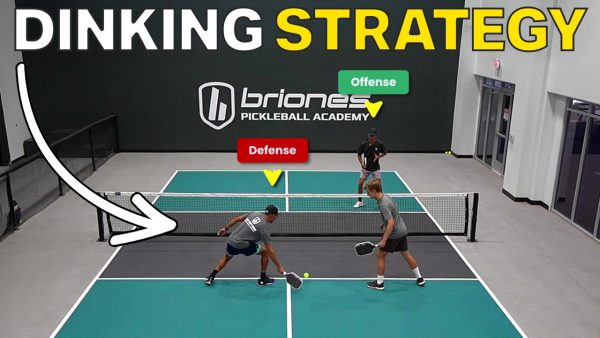
When all four players are at the kitchen line, use this simple strategy.
If you cannot attack the ball, keep it low and place it away from your opponents. This is the dink game. Soft shots that land at your opponent’s feet often force a pop-up.
Eventually someone makes a mistake, and that is when you attack.
Three Shots You Must Learn to Improve Faster
If you are serious about improving, you must master the return, the drop shot, and the fourth shot. These are the foundation shots of pickleball strategy.
Read more about that here:
Master These Three Pickleball Shots: Return, Drop, and Fourth Shot
A Free Resource for Beginners
I created a free resource called Pickleball Framework designed to give you clear fundamentals, key strategies, simple progressions, and a better tactical understanding of the game.
You can access it at PickleballFramework.com
This will accelerate your progress more than anything else.
Final Thoughts
You now understand how to play pickleball, how to keep score, where to stand, the key rules, and solid beginner strategy.
The next step is simple. Get on the court and start playing.
If this helped you, share it with a friend who is also learning the game.
See you on the court,
Jordan Briones