Hey there, it’s your coach Jordan Briones.
If you feel like you’re constantly on defense at the kitchen line — getting pushed back, reacting to everything, never really in control — I want to talk about why that’s happening and exactly what to do about it.
Because here’s the thing. A lot of players show up at the nonvolley zone with decent hands and decent dinks, and they still lose points they should be winning. Not because they’re doing something dramatically wrong, but because they’re missing a few specific habits that change everything about who controls the point.
Let’s go through each one.
Why Shallow Dinks Are Giving Your Opponent Everything They Want
The first thing I want you to think about is where your dinks are actually landing — not just whether they’re in or out, but specifically how deep they’re going.
When your dinks are landing in the middle of the kitchen, away from the line, your opponent has all the time in the world. They can set their feet, load up topspin, push dinks at your feet, and dictate the entire exchange. You’re essentially handing them control of the rally by giving them a comfortable ball to work with.
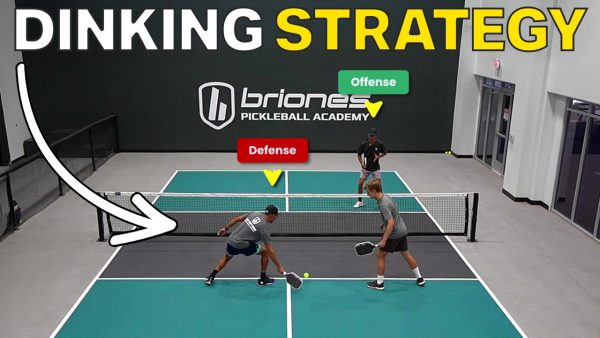
The fix is to push your dinks closer to the kitchen line. Right near their feet. Make them decide — do I volley this out of the air, or do I step back and take it off the bounce?
That decision is uncomfortable. And the more consistently you force it, the more defensive your opponent becomes, and the more offensive opportunities start showing up for you.
When your opponent is close to the line and you’re landing the ball near their feet, there’s no room to create. No room to load up and roll. No room to build momentum. They’re just trying to survive the shot. That’s exactly where you want them.
How Posture and Paddle Position Determine Whether You Take Balls Out of the Air
Leaning in and taking volley dinks — picking balls out of the air before they bounce — is one of the most powerful ways to take time away from your opponent. But most players miss these opportunities not because they lack the skill, but because their posture and paddle position aren’t ready for it.
If you’re standing tall with your paddle close to your body, you’re already too late. By the time you recognize the ball is catchable out of the air, the moment has passed.
What you want instead is a lower, more forward stance with your paddle extended out in front of you. From that position, leaning in to take a ball out of the air is a small movement, not a lunge. You’re already there. You’re already in attack mode.
There’s one important qualifier on this, though — and it’s something almost nobody talks about. The quality of your previous shot matters.
If you just hit a dead dink that floats back to your opponent, this is not the moment to be aggressively leaning in. They might speed up on you or roll aggressively, and if you’re already forward and committed, you’re going to be in trouble.
But if you just rolled a strong topspin dink that pushed your opponent off the line, and you can see their paddle face is open and they’re shuffling to recover? That’s your green light. Get low, lean in, and be ready to find something offensive.
Read the situation. Your lean-in posture should match the quality of the ball you just put out there.
What Your Volley Dinks Should Actually Accomplish — and the Mistake That Kills Your Advantage
Here’s where I see a lot of players throw away good positions without realizing it.
You’re at the kitchen line, you’ve done everything right, and you lean in and take a ball out of the air. Great. But then you send the volley dink right back to your opponent’s paddle. Now they’re the ones taking time away from you. Now they’re the ones dictating. And just like that, the advantage you worked for is gone.
Your volley dink needs to accomplish two things. First, it has to bounce — which means it has to land inside the nonvolley zone. Second, it has to make your opponent move. Get it toward the center line or the sideline. Make them shuffle. Make them reach. Make them hit on the move rather than from a set, comfortable position.
When you do that, you stay in the driver’s seat. When you don’t — when you give it right back to their paddle — you’ve handed the point back and now you’re reacting again.
Aim the volley dink with purpose every time. Not just “in the kitchen,” but specifically where in the kitchen, and why.
How to Turn Dead Dinks Into Scoring Opportunities
If you’re applying pressure with deep dinks and moving your opponent with your volley dinks, something good starts to happen. You start getting dead dinks back — short, soft, low-spin balls that float into the kitchen with no pace and no threat.
This is your moment. Do not waste it.
When you get a dead dink, you have two strong options. The first is a topspin dink rolled toward the line. Load it up, push it low and close to their feet, and either cause a short hop — a really tough ball to handle — or force them to shuffle off the kitchen line to play it. Either outcome puts them in a worse position than they were a second ago.
The second option is a speed-up. A dead dink gives you a cleaner platform to control your attack because the ball isn’t moving fast and it doesn’t have much spin. Pick your spot — right hip, body, left side — and drive it with intention. This is the moment to be offensive.
The key in both cases is that you’re choosing. You’re not just reacting to the dead dink and floating something back. You’re recognizing it as the opportunity it is and doing something with it.
How to Defend Pressure Dinks Without Getting Pushed Off the Line for Good
There are going to be stretches in a match where your opponent is the one applying pressure — rolling dinks near your feet, pushing you off the line, forcing you to make tough low contacts. That’s part of pickleball at every level.
When that happens, your first option is always to try to take the ball out of the air. Lean in, find the volley, don’t give up your position at the line if you can help it.
But when you can’t — when the ball is genuinely too low or too fast to take out of the air — you need to create space. Take a drop step back. Shuffle off the line with both feet. This is a key part of pickleball kitchen line strategy, giving yourself enough room to get the ball out in front of your body and make clean, controlled contact.
Most players get this part right. What they miss is what comes next.
The moment you’ve hit that neutralizing dink from your drop step position, you need to recover. Get right back up to that kitchen line as fast as you can and put yourself back in position to take the next ball out of the air.
If you stay back after being pushed off the line, you’re giving your opponent the kitchen line advantage and staying in a passive, defensive position. Recover immediately. The goal is always to get back to that line and take the initiative again as quickly as possible.
Court Positioning and Shading — The Last Piece Most Players Never Think About
This is the one that might surprise you, but it could be the most important thing you do for your doubles game at the kitchen.
When you hit a dink crosscourt — especially a wide, angled one near the sideline — your partner is going to shift toward their line to cover the down-the-line shot. And when your partner shifts to their line, the middle of the court opens up.
That’s your responsibility. You have to slide toward the middle and cover it with your backhand.
If you don’t, there’s a big gap right through the center and your opponent knows it.
The same thing works in reverse. When your opponent pulls you out wide and you’re hitting from outside your outside knee in a defensive position, your partner on the other side should be moving aggressively toward the middle. Because that defensive ball is most likely going to come through the center or toward their partner. They need to be there.
This is called shading, and it’s a simple habit once you internalize it. Wherever the ball goes wide, shift together. The player pulled wide covers their line. Their partner covers the middle. You’re always closing gaps and protecting the most likely return path.
When both players are shading well, it’s incredibly hard for opponents to find an opening. And when you’re on offense and rolling balls out wide, you’re also already positioned to handle whatever comes back.
Final Thoughts – Taking Control at the Kitchen Line
Everything here works together. Deep dinks create pressure. Pressure forces bad dinks. Bad dinks create volley opportunities. Volley dinks move opponents. Moving opponents creates dead dinks. Dead dinks create attacks.
It’s a chain. And once you understand the whole chain, you stop playing point to point and start playing with a system.
Pick one of these to focus on in your next session. Then stack them one at a time. The kitchen line is where pickleball is won and lost at every level — and the players who understand how to control it don’t just win rallies, they dictate them.
See you on the courts,
Coach Jordan Briones