Hey, it’s your coach Jordan Briones. If you’ve ever felt like you’re always a step behind in a fast hands battle — like your opponent just always seems to know where you’re going — it might be because you haven’t yet learned how to read your opponent in pickleball, and I want you to know something.
It’s probably not your reaction time.
It’s not your athleticism either.
What’s actually happening is that you haven’t been taught how to read the game before the ball even comes back to you. And once you understand this, firefights start to feel completely different.
How You Can Read Your Opponent and Stay One Step Ahead
Understand the Difference Between Reacting and Anticipating
The best players at the net aren’t just faster. They’re earlier. They’ve already decided where they’re moving before their opponent even swings.
That sounds like a superpower, but it’s really just pattern recognition. And once you understand the triangle theory, you can start doing it too.
Here’s the idea in its simplest form.
When you hit a ball to a specific spot on your opponent’s body, the return options are actually limited. Their paddle angle, their timing, their body position — all of it naturally funnels the ball toward predictable zones. Not every single time, but more often than not.
If you can hit your spot, you can start anticipating instead of reacting.
What Happens When You Jam Someone on the Inside
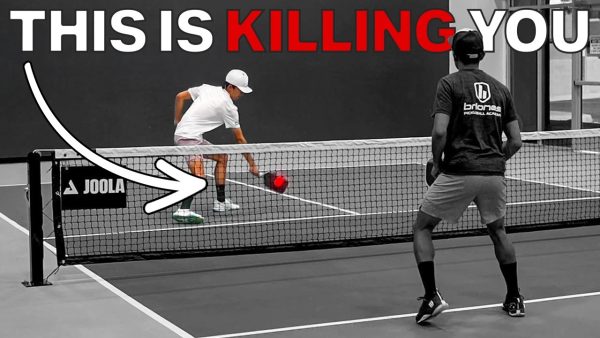
Let’s say you’re on the right side of the court and you attack a ball that lands right at your opponent’s dominant hip — kind of tucked into their body, making it tough to wind up on.
For them to rip that ball crosscourt, they’d have to be incredibly early. Their paddle would need to be way out in front, fully loaded and ready. And in a fast firefight? That almost never happens.
Instead, what you usually get is a late contact point. The paddle face closes slightly. The ball comes back toward the middle or down the line — not crosscourt.
That’s not luck. That’s geometry.
And once you recognize that pattern, you’re not guessing anymore. You’re reading.
Train Your Brain With the Two Ball Drill
This is one of my favorite drills to use with players who want to level up their hand battles, and all you need is a partner and two balls.
Here’s how it works.
Your partner stands at the kitchen line with two balls. They feed you a slightly high ball — just off your forehand side. Your job is to attack it low and toward their hip, keeping it tight and threatening.
The moment you hit that first ball, your partner immediately feeds the second one — right to where the pattern says it should come back. Usually down the line if you hit your spot on the inside.
Your job on the second ball is to be ready for it. Short, compact stroke. No big backswing. Just a quick punch to a good spot.
What this drill is really training isn’t just your hands. It’s your mentality. You learn to hit the first ball with intention, and then immediately shift into reading mode — not panic mode.
A lot of players miss that second ball early on because they’re already thinking about it before they’ve properly dealt with the first one. Sound familiar? You’ve got to stay present.
Compartmentalize. Finish the first shot, then move.
Make Sure Your Spot is Accurate
Here’s something I noticed when working through this with players — the triangle theory kind of falls apart if your initial attack isn’t actually a good ball.
If your first speed up goes straight to their midsection instead of out to their hip, they now have a lot more options. They can go anywhere from there. The pattern breaks down because you didn’t put them in a difficult enough position.
This is why spot selection matters so much. You can’t just attack hard and hope for the best. You have to attack with purpose — low, to a specific location — and then trust the geometry to do its thing.
The better your first ball, the easier your second ball becomes.
Final Say – Technical Tweaks for Better Positioning
When you’re working on the backhand side of this drill, there’s a small technical cue that really helps. After you hit your forehand attack, don’t let your right shoulder pull too far across your body.
Keep it in. Stay square. That’s what puts you in position to take that next ball cleanly in front of you instead of scrambling for it late.
And if you’re working on returning that second ball — try to take it straight back down the line first. Don’t try to change direction yet. Just get the timing right. Changing direction comes later once your timing is dialed in.
Go find a partner, grab two balls, and spend fifteen minutes on this. The firefights will start to slow down. Not because you got faster — but because you started seeing the game one step ahead.
See you on the courts,
Coach Jordan Briones