Hey there, it’s your coach Jordan Briones.
One of the biggest issues I see with players at the kitchen line is not that they lack the shots or the technique. It’s that they’re not aggressive enough. They’re backing off too early.
They’re giving up on balls they could be taking out of the air. And they’re missing opportunities to put pressure on their opponents simply because their mindset isn’t right.
I’ve been working with Kaden on his two handed backhand at the kitchen line, and one common tendency we noticed is that he has a habit of stepping back a little prematurely when committing to his two hander. A lot of pickleball players do this. They retreat before they need to.
So we’re going to change that mindset right now. And if you apply what we’re about to cover, you’re going to win more points at the kitchen line simply by being more aggressive and taking more balls out of the air.
How to Be More Aggressive at the Kitchen Line and Take More Balls Out of the Air
Adopt an Aggressive Mindset at the Non-Volley Zone
Here’s the new mindset you need to adopt. You’re going to take every single ball in the air until you can’t.
That’s it. That’s the shift.
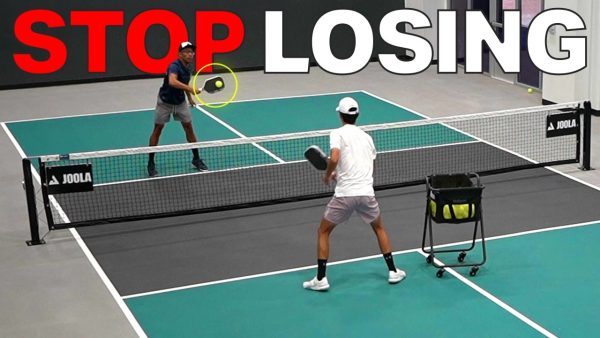
Instead of thinking about when to step back and hit your two hander, you’re going to hug the line with your toes all the way up there until you feel you need to retreat. And once you need to retreat, then you make the same gesture you typically make to hit your two hander.
But by staying up longer and committing to taking more balls out of the air, you’re going to find a few more opportunities to be aggressive. You’re going to put more pressure on your opponents.
And you’re going to start controlling rallies instead of just reacting to them.
Take More Balls Out of the Air to Create Offense
When you’re looking to be offensive and aggressive, you always want to be offensive out of the air first. That’s the key.
You want a really good wide stance and you’re going to try to take everything out of the air. Rolling is always the first option. Obviously if there’s a ball at net level, you’re going to be flicking or attacking. And if it’s below net level, you can put a little bit of topspin roll on it but you’re really just trying to move your opponent out.
When you cannot hit that ball out of the air, that’s when you move your feet to your two hander.
And here’s the most important part. When you move to hit that two hander and you know that you forced your opponent into a really tough ball or a half volley or you made them move, you’re going to come right back up to the line. You’re going to be squeezing and leaning in again.
This applies a lot of pressure and it also takes a lot of practice to be leaning in and then moving your feet right away if you cannot reach that ball. But this is something that all the pros are working on today.
Pro players like James Ignatowicz, Ryan Sherry, Augie Ge, and Casey Eubanks do this really well. If you watch them, they’re sticking their paddle out the whole way to really try and catch that ball out of the air first. And then if they can’t, they take a big shuffled angled step back to get themselves in a good position to hit that two hander.
Just giving yourself this look first will not only scare your opponents a little bit, but it also puts you in that mindset of I’m ready to attack always. And that is what’s really important.
Reset Your Position Immediately After the Two-Handed Backhand
Here’s something actionable you can do with a partner to train this pattern.
Have your partner feed you three balls that could maybe be taken out of the air. If they can’t be, you retreat and use that angled shuffle step for your two handed backhand. Then after the third ball, have them feed some balls that are a little bit deeper so you can choose to try to find offense there.
The goal is to lean in and work on the volley first, then create space for your two hander so you can really be aggressive on that shot.
You can start with three or four dinks and eventually go to five or six or seven dinks, or you can even attack maybe a little bit earlier. Based on the height of the ball, you’re mixing up your attacks from down the line or maybe a little bit more middle. You can roll down the line or roll middle or you can even flick middle or flick crosscourt.
The more balls you can take out of the air, obviously the more aggressive you can be. So really try and change that mindset to find more offense.
Choose the Right Balls to Attack Out of the Air
Here’s something critical that you need to understand. Every ball out of the air is not equal.
Depending on the height of the ball determines what you can do with it. We’ve all tried to be aggressive from a little bit too low and it doesn’t work.
If the ball is in that red zone around your knee area, you probably don’t want to be speeding up from there. Maybe you’re taking a traditional dink volley or maybe a little bit of roll, but you don’t want to be flicking from there.
You’re trying to find something around thigh level, especially around hip level. Those are the balls where you have real options.
When the ball is really low at shin level, you can still take it out of the air to take time away from your opponent. You can use an open paddle face or you can roll it. But these are balls that you don’t want to be attacking really aggressively. You can put a little bit of roll on it, but if you’re flicking from that position, those aren’t the ones you want.
On higher balls at thigh level or above, now you have options. You can dink roll or you could roll or flick up the line or down the middle or crosscourt. The higher that ball is, the more options you have.
Being Selective While Staying Aggressive
One of the important things is framing your mindset of still being offensive and still leaning in, but understanding that the lower that ball is, you’re going to have to swing slower and probably play something a little bit more conservative.
You still have to be very mindful of which balls you’re taking. In changing your mindset to taking more balls out of the air, you will start to see which balls you like to attack a little bit more and which balls you might need to be a little bit softer with.
At the end of the day, you’re going to be a little bit more aware of which balls you like to attack. You might get a ball where you could attack it, but you don’t love exactly where it’s positioned. So instead of forcing it, you hit another slightly more aggressive dink and you set yourself up for something a little bit higher and a little bit easier.
You’ll recognize that as you do this more and change your mindset more. You’re going to find balls that you can take out of the air where you’re like, hey, I can still be aggressive, but I can’t be my most aggressive self. So maybe I need to dial it back a little bit and set myself up for something better.
When you’re leaning in and taking balls out of the air, you’re taking time away from your opponent. And that creates massive pressure.
The most important thing if you’re hitting a dink volley roll is to get it to bounce. If it comes to your opponent and you’re trying to take time away and they just hit it out of the air, it defeats the purpose. You need to get it in the corner and make them move.
That’s what creates the advantage. That’s what forces the weak response. And that’s what gives you the next opportunity to attack.
Final Insights
The difference between players who control the kitchen line and players who just survive at the kitchen line comes down to mindset.
You need to commit to taking more balls out of the air. You need to hug that line until you absolutely have to retreat. And you need to be selective about which balls you attack while still maintaining that aggressive posture.
Stay up longer. Lean in more. Take more balls out of the air. And watch how much more offense you create simply by changing your approach.
See you on the courts,
Coach Jordan Briones