Hey, it’s your coach Jordan Briones.
Whether you’re just getting started or you’ve been playing for years, there are three strategies that will genuinely change the way you compete — and the best part is they work at every single level.
These aren’t complicated techniques. They’re not things you need a ball machine or a private court to practice. They’re smart, tactical habits that the best players use constantly — and most recreational players never even think about.
Let’s get into it.
3 Simple Court Strategies That Will Instantly Improve Your Pickleball Play
1. Stop Giving Them Easy Balls — Go After Their Feet
This is probably the single most impactful adjustment you can make right now.
A lot of players aim for the general area of their opponent — somewhere in the middle of their body — and wonder why their shots keep getting attacked. The reason is simple. When you give someone a comfortable ball to handle, they have all the time and space in the world to do whatever they want with it.
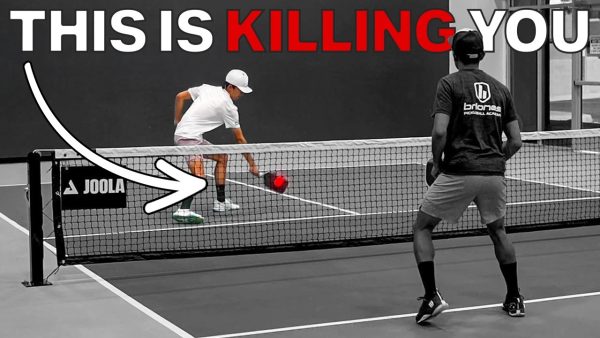
Pickleball backhand dink targets are critical — but when you push the ball down toward their toes? Now they have a problem.
Let’s start up at the kitchen line. When you’re dinking, most players are floating balls into the middle of the non-volley zone. That’s a gift. Instead, roll your dinks low and toward your opponent’s feet. Now they’re stuck making a tough choice — either take it out of the air as a low volley, which is hard to be aggressive with, or let it bounce and get pushed off the kitchen line. Either way, you’re in control.
Same idea applies when your opponents are stuck in the transition zone. This is actually where aiming at the feet becomes even more dangerous for them. They’re already in a tough spot — far from the net, hitting from a low position. If you keep putting the ball right at their toe line, you’re going to force weak replies, pop-ups, and unforced errors. That’s exactly what you want.
And if they’re pinned back at the baseline? Keep every ball as deep and close to that baseline as possible. You’ve got angles from the net, you’ve got the high ground, and they’re as far from the net as they can be. That’s a massive advantage — don’t give it up by floating balls short.
2. Use the Middle of the Court — It’s Your Secret Weapon
This one surprises a lot of players the first time they hear it. Going to the middle more often sounds almost too simple. But there are three really solid reasons why it works.
First — the net is lowest in the middle. Whether you’re at the baseline, in transition, or at the kitchen, you have the most clearance when you aim through the center of the net. That margin matters, especially when you’re under pressure.
Second — it cuts off your opponent’s angles. When the ball is near the sidelines, your opponent has tons of options. They can go down the line, through the middle, or rip a sharp crosscourt angle. But when the ball comes at them through the middle, those wide angles disappear. If you and your partner are shading correctly and squeezing the center, they’re basically forced to hit it right back at you.
Third — you’re going to make fewer errors. Simple as that. Hitting toward the middle of the court means you’re never going to spray it wide. And on top of that, it can create a little confusion between two opponents who both think the other one has it covered.
Going middle isn’t passive. It’s strategic. When you consider pickleball backhand dink targets and do it with intention, it sets up everything else.
3. Follow the Ball With Your Feet — Shade Like a Pro
The third strategy is shading — and once you understand it, you’ll never look at court positioning the same way again.
The basic idea is this: wherever the ball goes, your feet follow. You and your partner are always adjusting together based on where the ball is on the court.
For example, if you’re on the left side and the ball is down in the corner near your sideline, you shift toward it and cover that down-the-line shot. At the same time, your partner slides toward the middle and protects the center. You’re working together, closing gaps, and covering the most likely return paths.
Flip it to the other side and the same principle applies. Your partner on the right covers their line, you move to squeeze the middle. The ball dictates where you go — not habit, not guessing.
When you shade correctly, two things happen. First, you’re always in a strong counterattacking position because you’re already where the next ball is most likely going. Second, you and your partner stop bumping into each other or leaving big open gaps in the middle because you’ve got a clear system for who covers what.
Most recreational players stand in the same spot and react. Players who shade move with purpose — and that difference alone will win you a lot of points.
Final Thoughts
Three strategies. Aim at the feet. Go to the middle. Follow the ball with your feet.
None of these require a special paddle or years of elite training. They just require awareness and the willingness to play with intention every single time you step on the court.
Pick one of these to focus on in your next session. Just one. Build it into your game until it becomes automatic, then layer in the next one.
That’s how you level up.
See you on the courts,
Coach Jordan Briones