Hey there, it’s your coach Jordan Briones.
If you have ever felt helpless against a banger, you know exactly what that feeling is. The ball is coming at you fast, it is heading toward your backhand side, and your counter just doesn’t have enough on it to do any damage. So the banger keeps doing what they are doing because there are no consequences.
That changes today. There is one simple addition you can make to your game that gives you real power on your backhand counters. And once your opponent feels it come back at them, they start thinking twice about driving every single ball.
How to Add a Two-Handed Backhand Counter to Shut Down Bangers
Understand Why Your One-Handed Backhand Loses Power on Wide Balls
For balls hit directly at my body, a one-handed punch volley works really well. I can protect my chest and waist, push from my shoulder, and stay in a strong position. That shot does its job.
But when the ball is heading outside my left hip or past my left shoulder, a one-handed backhand loses its leverage. I am stretching, my arm is extended away from my body, and I just cannot generate the kind of power that makes a banger uncomfortable. The counter comes back soft and the rally continues on their terms.
The fix is adding your non-dominant hand to the paddle on those wide backhand balls. That second hand completely changes the equation.
Adjust Your Grip to Handle Power Players and Counter Bangers More Naturally
The grip adjustment is simpler than most players expect. If you are already holding a Continental grip for your one-handed punch volley, all you do is place your non-dominant hand on the paddle above your dominant hand.
Some players add a finger over the top for extra stability. I personally like two fingers over the top of my right hand. Find what feels most secure and comfortable for you.
The beauty of this setup is that you can switch back and forth quickly. If the ball comes straight at your body, release the non-dominant hand and go back to your one-handed punch volley. If it moves outside your left hip, add the second hand and unload on it. With practice that transition becomes automatic.
Use This Shot in the Two Situations Where It Does the Most Damage
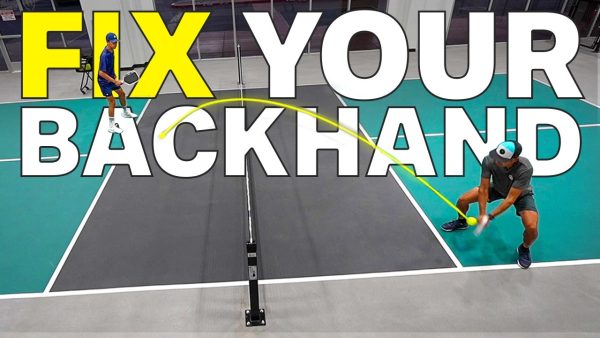
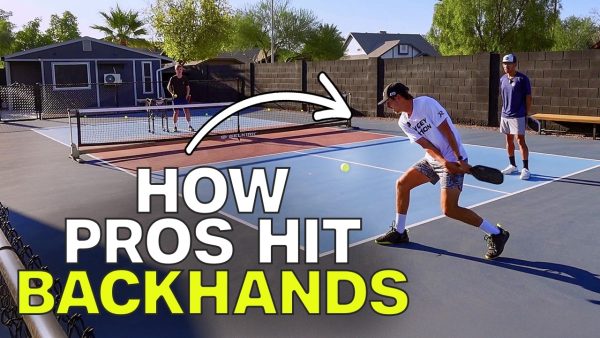
On the left side of the court, the most common attack you will face is a drive down the line. Instead of reaching out with a weak one-handed backhand, turn your shoulders, set up in your two-handed position, and swing through with both hands behind the paddle. The difference in power and stability is immediate.
On the right side as a right-handed player, when the ball is crosscourt from you, a lot of attacks and drives are going to come through the middle. In that scenario you can sit in your two-handed backhand grip as your ready position, fully prepared to counter anything coming that way. If the ball shifts and comes straight at your body, release the top hand and use the one-handed punch. You are covered either way and your opponent has no easy target.
Turn Your Shoulders First to Generate Real Power
Here is the thing most players miss when they first try this shot. They think the power comes from swinging harder with their arms. It does not.
The power comes from turning your shoulders and hips.
When you turn your shoulders into the shot, your hips follow naturally and your paddle goes back with you without you having to consciously pull it back. That coiled position is where all the force is stored. From there you simply unwind toward your target and let the swing happen. Stay relaxed through it. You will be surprised how much pace you generate without muscling it at all.
A common mistake is pulling the paddle back independently without turning the body. That position is weak and disconnected. Turn the shoulders first and let the paddle follow. That is the sequence.
Master the Correct Swing Path to Defend and Counter Hard Drives Effectively
For balls around hip to shoulder height, your paddle should start at or just below the height of the ball. Swing through and finish up above your right shoulder. That is your target finish point on most counters.
For higher balls, this is where players struggle most. When a ball is coming in at head height, a lot of players start their paddle too low and then mishit or miss completely trying to get up to that contact point. For those higher balls, start your paddle closer to the height of contact, not below it, and then drive through toward that right shoulder finish.
The follow through direction tells you a lot. If you are consistently finishing in a good spot, your swing path was right. If your paddle is drifting somewhere else at the finish, something went off earlier in the swing.
Recover Back to Ready Position Immediately After Your Counter
This last piece doesn’t get talked about nearly enough.
Because you are taking a bigger swing on this shot than a standard punch volley, the ball can come back at you faster than you expect. The players who do this shot well are not just thinking about the counter they just hit. They are already moving back into their ready position the moment the paddle finishes.
Make that recovery automatic. Hit the counter, get back into position, and be ready. The shot you just hit might be powerful enough to end the point, but if it comes back you want to be ready to do it again.
Go grab a partner and have them feed you slow to medium pace balls toward your left side. Focus on the shoulder turn first. Get comfortable with how the paddle naturally goes back when your body rotates. Once that feels right, start building speed into the swing. The power will come on its own.
Bangers win when their opponents have no answer. This is your answer.
See you on the courts,
Coach Jordan Briones