Hey there, it’s your coach Jordan Briones.
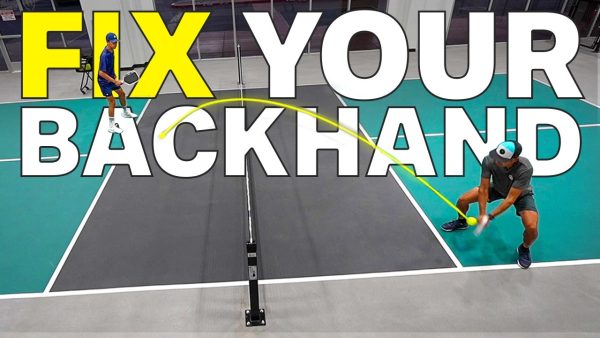
I recently had the chance to work with Connor Garnett — one of the best players in the world and someone who has one of the cleanest two-handed backhands you will ever see — and I have to tell you, what he broke down for me completely changed how I think about this shot.
Whether you’re building your two-hander from scratch or you’ve been hitting it for years and something still feels off, this is the breakdown you’ve been waiting for.
Let’s get into it.
The Three Things That Actually Matter on the Two-Handed Backhand
Before we get into fixes and adjustments, Connor laid out the foundation. And the reason I want to start here is because there’s a lot of noise out there about technique — grip, backswing, stance — and most of it misses the three things that actually create a consistent, powerful drive.
1. ) Kinetic Chain
Specifically, getting the left hip involved. The left hip driving through the shot is where the power comes from. It’s not the arms. It’s not even really the hands. The hips initiate, and the arms follow. When you feel that left hip come through and pull the paddle out naturally, that’s the shot working the right way.
2. ) The Low to High Motion
This is what generates the spin. The paddle has to approach the ball from below it and swing upward through contact. That upward path is what puts rotation on the ball and keeps it from floating. No low to high, no spin. Simple as that.
3. ) Acceleration Through the Contact Zone
As the paddle comes out, it should be speeding up — not constant speed, not slowing down. The fastest point of the swing should be right at and through the ball.
Connor’s point was that players come in all different shapes with different backswings and different stances, and that’s fine. What he watches for is whether those three things are present. If they are, the shot is going to work. If they’re not, no amount of technical adjustment is going to save it.
What Connor Noticed in My Swing — and How He Fixed It
I’ve been working on my two-hander a lot recently, so I asked Connor to take a look. His feedback was specific, and I think it applies to a lot of players at every level.
The first thing he pointed out was a slight lean back on my finish. When the shoulders pull back instead of staying forward through the shot, the ball wants to go up. It’s just physics — your energy is going backward, and the ball follows that energy. The fix is to keep the shoulders leaning forward through contact and into the finish. That forward lean keeps the ball low over the net and takes away that pop-up tendency.
The second thing he mentioned was about getting the paddle to drop a little lower before contact. A paddle that drops below the wrist right before you swing gives you that extra brush up the back of the ball. More brush equals more spin. More spin equals more dip. And more dip equals a ball that’s way harder to attack on the other side.
Two adjustments. Both simple. Both immediately noticeable in how the ball comes off the paddle.
What Connor Says About Grip Pressure — and Why You Might Be Overdoing It
This is one of those things that sounds too simple to matter, but it makes a real difference.
Connor’s grip pressure on the two-hander? Around a four out of ten.
If you’re sitting there thinking about your grip pressure while you’re swinging, it’s probably too tight. Tension in the hands transfers through the arms and kills the natural whipping motion that creates power and spin. When you’re relaxed, the hips can do their job, the arms can follow freely, and the contact feels clean and connected instead of forced.
Loosen up. Let the mechanics do the work. The power is in the movement, not the squeeze.
How Connor Controls Direction — Down the Line vs. Crosscourt
Connor has arguably the best two-handed backhand in the game right now, so I had to ask him how he controls direction so precisely. His answer was something I hadn’t heard explained quite this way before.
For a down-the-line shot, he really leans into it — holding the finish out toward that target, staying through the ball longer. That commitment to holding through is what keeps the ball on that down-the-line path.
For crosscourt, the hips face the crosscourt target at the end of the swing. Where the hips finish is where the ball goes.
Now you might think — doesn’t that telegraph the shot? Connor’s answer was no, because the hips face the target after contact, not before it. By the time your opponent can read your finish position, the ball is already past them. The disguise happens at the contact point, which is where both shots look identical.
And speaking of the contact point — this is where he said the real accuracy lives. He described it as imagining a second ball right in front of the actual contact point and hitting through both. For down the line, you’re hitting through both balls in that direction. For crosscourt, same concept but across. That “hit the second ball” feeling is what creates consistent directional control shot after shot.
What Connor Found in Grayson’s Swing — and What Most Players Get Wrong
We also had Connor take a look at Grayson’s two-hander, and the feedback was worth sharing because it’s incredibly common.
The first thing was contact point. Grayson was making contact too close to his center rather than out to his side. When you make contact more out to the side of your body, it allows the hips to drive through naturally and the arm to throw after the ball. The shot feels more fluid and less like you’re muscling it.
The second thing — and this one shows up constantly — was not dropping the paddle head enough before contact. Paddle below the wrist. That’s the cue. The more the paddle head drops below the wrist before you swing upward, the more brush you can generate on the back of the ball. It’s the foundation of the low to high motion, and without it, the ball just doesn’t spin the way it should.
The third was the same thing Connor noticed in my swing. Staying low on the finish. When you open up your body and your energy goes outward instead of forward, the ball naturally wants to rise. Staying on that level plane — shoulders forward, body driving through — is what keeps the drive low and effective.
How Much Weight Should Be on Your Front Leg at Contact?
This came up while working with Grayson and it’s one of the best specific questions we went through.
Connor said that at contact, he’s got about 80% of his weight on his front leg — and then by the time he makes contact, it’s essentially 100% transferred forward. That full weight transfer is what gives the drive its penetrating power. The hips coming through and the weight loading onto that front leg are working together.
The one caveat: if the ball is coming in deep and you’re not moving forward through it, the split might start closer to 60/40 or even 50/50. But the transfer still happens. The ball location determines where you start, but the transfer to that front leg at contact is always the goal.
If your drives feel weak or inconsistent, check your weight. Are you staying back? Are you balanced equally on both feet through contact? Get that weight moving forward and you’ll feel the difference immediately.
Final Thoughts – Building a Two-Handed Backhand That Holds Up Under Pressure
Here’s what I took away from this entire session. The two-handed backhand isn’t about perfecting one thing — it’s about getting these pieces working together as a connected system.
Left hip drives the chain. Paddle drops below the wrist and brushes upward. Shoulders stay forward through the finish. Weight transfers to that front leg. And the contact point — out to the side of your body — is where accuracy and power live simultaneously.
Get on the court and work through these one at a time. Start with the hip drive. Feel the kinetic chain actually do its job. Then layer in the low to high, the forward lean on the finish, and the weight transfer.
Connor is one of the best in the world for a reason. And the good news is that what makes his two-hander great isn’t magic. It’s mechanical. It’s learnable. And with the right reps and the right focus, it’s available to you too.
See you on the courts,
Coach Jordan Briones