Hey there, it’s your coach Jordan Briones.
The rules are changing. Again.
And if you’re out there playing tournaments, rec play, or DUPR events, some of these updates are going to catch you off guard if you’re not paying attention. I’ve seen players lose points — points they absolutely should have won — simply because they didn’t know the current rules.
I want to clear all of that up right now. One important thing to note before we get into it: everything I’m covering here applies to non-PPA touring pros. If you’re playing at the pro level on the PPA tour, different rules apply. But for everyone else — recreational players, tournament competitors, DUPR grinders — this is exactly what you need to know in 2025.
Let’s get into it.
What Every Tournament and DUPR Player Needs to Know: 2025 Pickleball Rule Changes
Don’t Assume a Replay — Let Serves Are Live Under 2025 Rules
This one trips people up more than you’d think. On the PPA pro tour, a let serve stops the rally and the server re-serves. But if you’re not playing in a PPA pro event, that is not the rule for you.
Let serves are played. Full stop.
That means if your opponent’s serve clips the net and still lands in the correct service box, the rally is live. You need to be ready for it. That ball might bounce short and die near the kitchen, or it might take a weird angle and push deep into the court. Either way, it’s your job to make a play on it.
The worst thing you can do is just stand there and watch it land because you assumed the point would be replayed. Stay alert, move toward the ball, and keep that rally going.
Out Calls Must Be Immediate — No Delayed Calls
Knowing when a ball is out is one thing. Knowing when you’re allowed to call it is another.
The rule is simple but gets violated constantly. If you see the ball land out, you call it right away. You raise a finger, you say “out” loud enough for the referee to hear, and you do it immediately after the ball lands.
What you cannot do is let your opponent hit their next shot and then call it out. That window is closed. Once your opponent has struck the ball, or once the ball has crossed the plane of the net back toward your side, you have lost the right to make that call.
If you want to win more points and avoid arguments on the court, train yourself to be decisive. See it out, call it out. No hesitation, no waiting to see what your opponent does next. Quick, clear, and immediate.
Serve Rules in 2025 Are More Flexible Than You Think
There’s been a lot of confusion around the serve, and honestly, I get it. The rules have shifted a few times and there’s a lot of misinformation floating around. Let me break it down clearly.
First, the volley serve. You are allowed to toss the ball up before striking it. You can toss it as high as you want. What you cannot do is add spin with your fingers during the release. The ball has to leave your hand cleanly. And regardless of how high you toss it, you still have to make contact below your waist. That rule has not changed.
Now, the drop serve — or what some people are calling the release serve. This one is actually pretty freeing once you understand it. You can drop or release the ball from any height. Low drop, high drop, it doesn’t matter. The only restriction is that you cannot apply force or spin when you release it. You’re letting gravity do the work.
Here’s where it gets interesting. Once you’re doing a drop serve, the waist-height contact rule no longer applies. You can swing down on it, sidearm it, do whatever you want with your swing path. That flexibility is gone with the volley serve but fully available with the drop serve.
One more quirky detail: with the drop serve, you can actually let the ball bounce more than once before you hit it. There’s no rule against it. Is there any real tactical reason to do that? Probably not. But it’s legal, and now you know.
One Foot on the Ground at Contact — No Exceptions
This applies to both the volley serve and the drop serve, so make sure you’re clear on it.
When you strike the ball on your serve, at least one foot must be in contact with the ground. You do not need both feet down. A lot of players generate forward momentum by loading their back leg and stepping through, and when they make contact, only the lead foot is touching the ground. That is completely legal.
What’s not legal is jumping or being fully airborne at the moment of contact. As long as that one foot is planted when you hit it, you’re good.
Don’t Rush the Serve — Wait for All Three Numbers
This is one of those rules that feels minor until it costs you a point.
Before you serve, the referee has to call three numbers: the server’s score, the receiver’s score, and the serve number — either one or two. You are not allowed to strike the ball until the referee has finished saying all three of those numbers.
In practice, a lot of players get into a rhythm and start their serve motion too early. They’re eager, they’re in their groove, and they step up and swing before the ref finishes calling “two.” That’s a fault.
My advice? Use the score call as part of your routine. Let the ref finish. Take a breath. Get into your stance. Then serve. That small pause is not wasted time — it’s smart, composed pickleball.
Returners Have the Right to Signal Not Ready
This one is short but important, especially in tournament play.
After a point ends and you’re moving to a new position on the court, the server can step up to the line and the referee will call the score right away. If you’re not in position or not ready, you don’t have to just deal with it.
You can put your hand up or say “wait” before the score is called. That signals to the ref that you need a moment. Once you lower your hand or indicate you’re ready, the ref will call the score and play continues.
Use this when you need it. There’s no penalty for it. Wipe your hands, catch your breath, get your feet set. Play the point when you’re actually ready.
New Clarification on Paddle Contact in the NVZ
This is probably the most interesting rule update in 2025, and I think it’s going to change how some players approach low balls at the kitchen.
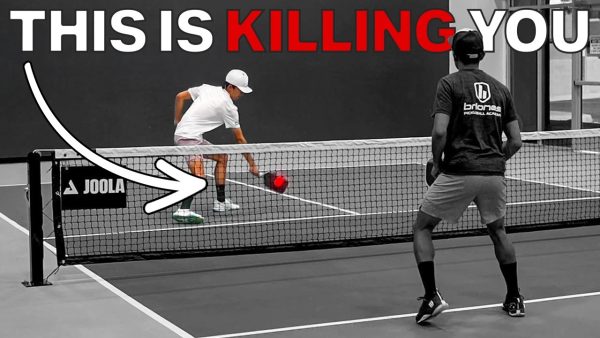
Here’s the scenario. You’re at the non-volley zone line, you’re getting low to play a tough ball, and your paddle scrapes or touches the ground inside the NVZ before you volley the ball. In previous years, that was a fault. In 2025, it is not.
The reasoning makes sense when you think about it. If your paddle is touching the NVZ floor and your feet are behind the line, you are established outside the zone. The moment you lift your paddle off the ground and then make contact with the ball, that contact is clean. You haven’t crossed into the NVZ with your body.
The key is timing. Your paddle touching the NVZ must happen before contact, not after. If you volley the ball and then your paddle or body falls forward into the NVZ, that’s still a fault. The sequence matters.
Ernie Attempts — What Happens When You Go for It and Miss
The Ernie is one of the most exciting shots in pickleball, and the rules around it are worth knowing cold.
When you hit an Ernie, you’re going for the ball on the side of the post, outside the non-volley zone. Your contact has to happen on your side of the net. After contact, your follow-through can carry your paddle past the plane of the net. That’s perfectly legal as long as you actually hit the ball first.
Here’s the part that gets people in trouble. If you go for an Ernie and you miss — you don’t make contact with the ball — and any part of your body or paddle crosses the plane of the net, that is a fault. You can fake the motion, you can bluff, you can try to make your opponent flinch. But if you miss the ball and you’ve already crossed that plane, the point is theirs.
If you’re going to go for an Ernie and you’re not sure you’re going to get it, keep everything on your side. The risk is not worth the fault.
Wrong Position on the Court — Court Position Mistakes in 2025 Pickleball
This one is a big change, and I think it’s going to reduce a lot of confusion and arguments on the court.
If you end up receiving from the wrong side or serving from the wrong position, the point is not automatically stopped and replayed. The point has to be played out unless the referee catches it or someone on the court stops play immediately.
If the point finishes and no one stopped it, that point stands. It counts. You don’t get a do-over.
Now, here’s my advice if you notice during the rally that someone is in the wrong position. Think carefully before you stop play. If you stop the point and it turns out you were wrong — that everyone was actually in the correct position — you lose the point. That’s a real consequence.
The smarter move in most cases? Play the point out. If you win it, great. If positions need to be corrected, sort it out between rallies. I’d rather risk playing from a wrong position than risk losing a point I wasn’t sure about.
Final Thoughts – Know the Rules, Win More Points
Here’s the bottom line. The rules of this game are not something you can just pick up as you go. They’ve changed, they keep changing, and not knowing them is a disadvantage you’re handing your opponents for free.
Let serves are live. Out calls must be immediate. The serve has more flexibility than most people realize. One foot down at contact. Wait for all three numbers. Returners can signal not ready. Paddle touching the NVZ before contact is legal in 2025. Ernie misses that cross the net plane are faults. Wrong position points stand if no one stops play.
That’s a lot to take in. But now you know it. And knowing it is what separates players who compete with confidence from players who second-guess themselves in the middle of a point.
Go back out there, play smart, and play by the current rules.
See you on the courts,
Coach Jordan Briones