Hey there, it’s your coach Jordan Briones.
There is a lot of advice floating around out there. Tips from coaches, suggestions from other players, things you’ve picked up watching YouTube videos or hanging out at the courts. Some of it is great. Some of it is actually holding you back.
Today I want to talk about five specific things that I see players doing all the time — things they genuinely believe are helping them — that are quietly sabotaging their game. And the frustrating part is that most players have no idea.
Let’s clear this up.
Mistake #1: Hitting Your Return Harder Without Thinking About Your Position
This is probably the most common one I see right now, and it makes sense given how the game is evolving. The game is getting faster and more aggressive, and the advice going around is to return the ball harder, deeper, with more topspin. And look — there is truth to that. A faster return with more pace does give your opponent less time to set up.
But here’s what players keep forgetting.
It also gives you less time to get up to the non-volley zone.
Everyone talks about hitting the return deep. That is important. But just as important — maybe even more so — is how close you can get to that kitchen line before your opponent’s third shot arrives. If you’re blasting returns and getting stuck at the baseline or stuck in the transition zone while good players are driving at you, that pace advantage disappears fast.
Here’s how to think about it. Your return has to do two things: land deep enough to push your opponent back, and give you enough time to get into a strong position up at the line. If your mobility is really good and you’re moving forward through your return, by all means, drive it. But if you’re consistently getting caught mid-court on the fourth shot, your return is too fast for where your feet are.
Sometimes a slower return with more arc is the smarter play. It buys you time. It gets you to the line. And being at the line in a strong position is worth more than a slightly faster ball.
Mistake #2: Trying to Reset Every Single Ball Against a Banger
I see this one play out the same way every time. A team is up against bangers, they’re getting hammered with hard drives, and their strategy is to just block everything soft and hope the bangers make errors.
That strategy has two serious problems.
First, soft weak returns are exactly what bangers want. They are in an offensive mindset. They are trying to beat you with pace and take away your reaction time. When every ball you give them floats back gentle and inviting, you are not discouraging them at all. You are feeding them. They will keep driving, keep stepping in, keep attacking — fifth shot, seventh shot, all day.
Second, when players try to block and reset under pressure, those balls are usually landing right in the banger’s strike zone. Not only are you not slowing the game down, you are handing them perfect balls to hit.
The real answer against bangers is confidence and precision in your counter volleys. Get the ball to their feet. A good banger needs space and time to load up and drive. Take that away. When your volleys are consistently low and tight at their toes, they can’t set up properly. Their drives get weaker, less consistent, and you start winning those exchanges.
Stop trying to soften every ball. Start attacking the feet.
Mistake #3: Taking Every Ball Out of the Air Regardless of Contact Point
Taking balls out of the air is a great weapon. It takes time away from your opponent, forces them to react earlier, and lets you play more offensively at the kitchen. I am all for it.
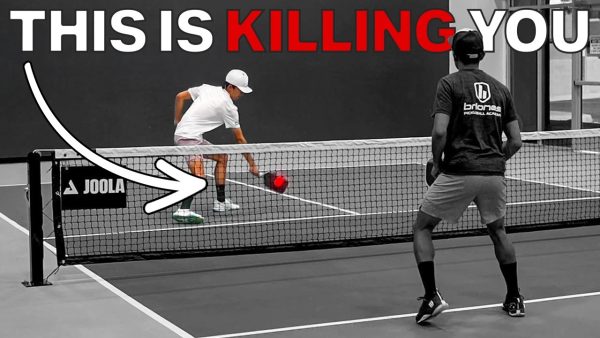
The problem is when players take this idea too far and start volleying everything — including balls that are coming in at or below knee level.
That is the red zone. And hitting from the red zone is costing you points.
When you volley a ball that’s at shin level or below, you are forced to hit with an extreme upward trajectory just to clear the net. That trajectory gives the ball a very floaty path and almost no way to be aggressive. You’re not putting pressure on anyone. You’re just hoping it goes in and lands somewhere useful.
Here is the simple guideline I use. If I can take the ball out of the air and my contact point is at thigh level or above, I take it. I roll it or put it back with pace and I’m being offensive. But if that ball is dipping below my knee, I let it bounce. I create some space off the line, I let it come up to the apex of the bounce, and now I have a higher contact point and a real opportunity to be aggressive.
The bounce is not a retreat. It is a reset into a better position. Use it.
Mistake #4: Practicing Third Shot Drops From Unrealistic Feeds
A lot of players spend serious time working on their third shot drop. That dedication is great. The problem is how they’re practicing it.
I see it constantly. Someone sets up a ball machine or has a partner hand-feed them a slow, easy ball from across the net. They practice their drop from that feed over and over. The ball arcs beautifully and lands soft. They feel like they’re getting better.
But here’s the truth. Those reps are training the wrong thing.
In a real game, your opponent’s return is coming in with pace, topspin, or awkward placement. It is not a gentle floated feed from a basket. When you only practice from easy balls, you get comfortable hitting high-arcing drops that bounce up inside the non-volley zone. And at any competitive level, those high bouncing drops are getting crushed right back at your feet.
If you are going to put time into your third shot drop, practice it from realistic balls. Have your partner hit you an actual return with pace. Or feed you something with the kind of spin and speed you would see in a match. That is the only way you are building a drop that holds up when it matters.
And one more thing — if you are below a 4.0 level, the third shot drop is not the most critical skill for you to be grinding right now. Your serve, your return, and even your third shot drive deserve just as much attention. Do not neglect the full picture just because you’ve heard the drop is important.
Mistake #5: Copying the Open Stance Serve Without the Foundation to Support It
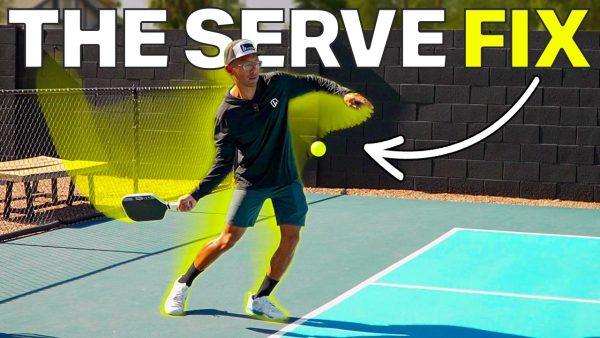
You’ve probably seen the pros serving from a wide open stance, loading through their legs, rotating their core, and generating serious topspin and pace. It looks explosive. It looks powerful. And it is — for them.
The reason pros can do this is because most of them came up through tennis. That open stance core rotation is natural for them. Their legs are strong, their core is strong, and their flexibility lets them unwind through the shot without losing balance or control.
If that is not your background, copying that serve directly is going to give you an inconsistent, off-balance result.
That does not mean you should never try it. Experiment with both. But understand what each one requires. The open stance serve demands strong legs, a strong core, and real rotational flexibility. Without those, you are just spinning around and losing power, not gaining it.
The closed stance serve uses forward momentum instead of core rotation. You are stepping into the ball and driving through it. For most recreational players, especially those who are still building that physical base, the closed stance is going to be more reliable, more consistent, and honestly just as powerful when executed well.
Do not copy a technique just because the pros use it. Understand why it works for them and whether your body is ready to support it. Build the foundation first, then layer in the advanced mechanics.
Final Thoughts
None of these five mistakes are about talent. They are about habits and understanding. And habits can be changed.
Stop sacrificing your position for return pace. Stop feeding the bangers soft balls. Start being selective about what you volley and from where. Practice your drops from realistic feeds. And choose a serve stance that actually matches your physical ability right now.
Pick one of these to focus on this week. Just one. Get deliberate about it in your next few sessions. Build that correction into your game until it becomes automatic.
That is how real improvement happens. One fixed habit at a time.
See you on the courts,
Coach Jordan Briones