Hey there, it’s your coach Jordan Briones.
If you’ve never played tennis or any other racket sport and you’re trying to figure out how to actually put topspin on the ball, I want you to know something before we get into it.
This is not as complicated as most people make it.
There are a few simple things you can change right now that will immediately start creating spin on your shots. No background in racket sports required. Just an understanding of what’s actually happening at contact and how to make it happen on purpose.
Let’s get into it.
How to Generate Topspin in Pickleball (Even If You’ve Never Played a Racket Sport)
Fix Your Grip Before You Try to Create Spin
Most recreational players use a Continental grip, also called the hammer grip. It’s natural, it’s comfortable, and it works fine for a lot of shots.
But for topspin, it’s working against you.
The Continental grip leaves your paddle face slightly open at contact. And an open face means the ball tends to float rather than dip. Switching to an Eastern grip closes that face just enough to make a real difference. You’re not making a dramatic change. It’s subtle. But that subtle shift in how the paddle face sits at contact makes topspin a whole lot easier to generate.
Try it and see how it feels. It’s not a hard rule, but it will make everything else easier.
Drop Your Paddle Head Below the Ball First
Okay, here’s the thing that actually creates topspin. Not the grip, not the wrist. This is it.
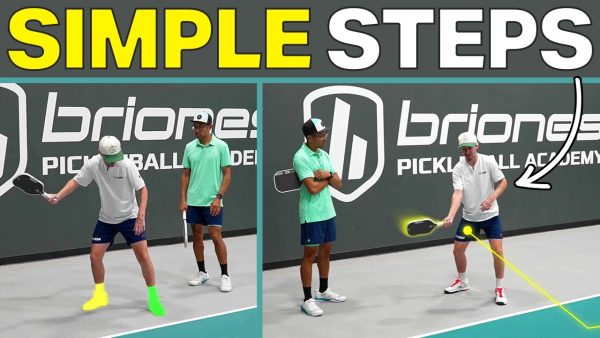
You have to drop your paddle head below the ball before you swing.
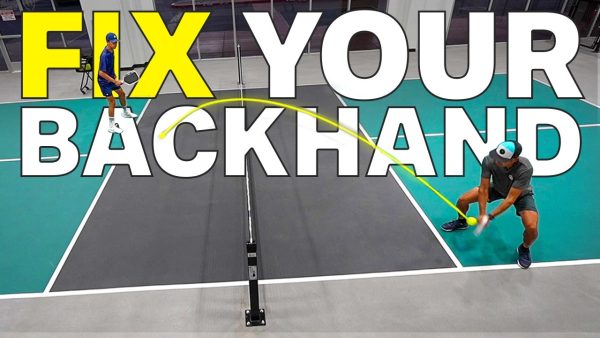
Think about it this way. If you want to swing upward through the ball, you have to start below it. You cannot start at ball level and swing up. You cannot start above it. The lower you get that paddle tip below the point of contact, the more room you have to swing vertically through the ball on the way up. That upward motion through contact is exactly what causes the ball to spin forward.
This is the piece that most players are skipping. They meet the ball at level and push through it, which gives them a flat shot every time. Drop the paddle head first. Everything changes from there.
Stop Snapping Your Wrist and Let Your Forearm Rotate
A lot of players assume that topspin comes from snapping or whipping the wrist. It feels like that’s what should create the rotation. And that assumption causes a lot of problems.
When you try to create spin by flicking the wrist, the ball pops up higher than you want and your consistency goes out the window. The wrist actually needs to stay fairly stable through contact and all the way through the follow through.
What you will see in a good topspin stroke is something called pronation, which is just your forearm rotating slightly as you swing upward. That is a very different motion from a wristy flick. It’s controlled, it’s consistent, and it lets you swing with more speed without losing accuracy.
So if you’ve been trying to whip your way into topspin, let that go. Keep the wrist firm, swing from the shoulder, and let the forearm do the turning.
Finish High If You Actually Want Topspin
Here’s a quick self-check you can use any time you’re practicing.
After you hit the ball, where does your paddle end up?
If it’s finishing out in front of you, pushed toward the net, you’re swinging in a linear path. Linear swing paths create flat balls. That’s not topspin.
A real topspin finish is high. On a topspin dink especially, your paddle should end up just outside your cheek on the same side you hit from, coming straight up on the ball. Watch the top pros hit a topspin dink and you’ll see exactly this. The finish is tight, high, and very much vertical. That’s not just how it looks. That’s what the swing requires.
Use the Same Low-to-High Swing on Your Swinging Volley
Once the topspin dink starts clicking, the swinging volley uses the same exact ideas. The only real difference is that the ball is in the air, which means you have to get your body low to create the same low-to-high swing path.
Get into a wide, low stance first. That stance is what gives you the ability to drop your paddle below the ball even when things are moving fast. From there it’s the same story. Stable wrist, upward swing, a little forearm pronation through contact.
If you want to add more pace to the swinging volley, increase your pronation and let the finish come up and across toward your opposite shoulder. That windshield wiper motion keeps the swing path vertical while letting you swing faster. What you want to avoid is swinging out toward the ball in a straight line. That’s how you hit the net or send it long.
The swing goes up. Not out.
Start with the grip, drop the paddle head, keep that wrist stable, and finish high. Work through each piece separately before putting it all together and you’ll be surprised how quickly this starts to feel natural.
Topspin is not just for advanced players. It’s a skill anyone can develop with the right mechanics and a little focused practice.
See you on the courts,
Coach Jordan Briones