Hey there, it’s your coach Jordan Briones.
If your backhand feels like the weakest part of your game right now, you’re not alone. It’s one of the most common things I work on with players at every level. And the good news is, the problems are almost always the same ones.
Fix these and your consistency goes up immediately. I can almost guarantee it.
How to Fix Your Backhand with Simple Adjustments That Instantly Improve Consistency
Stop Letting the Ball Crowd You on Your Backhand
The first thing I want to address is spacing, and specifically what happens between the bounce and your contact point on the backhand side.
What I see constantly is players not moving their left foot out of the way when the ball bounces near it. They just stand there and let the ball rush them. When that happens, your contact point ends up way too close to your body or even behind you, and from there you have almost no control over where the ball goes.
There’s another problem that comes with it. When you don’t create that space, you end up making contact right off the ground on a half volley. The ball is low, below the net, and now you’re on defense before the point even really starts.
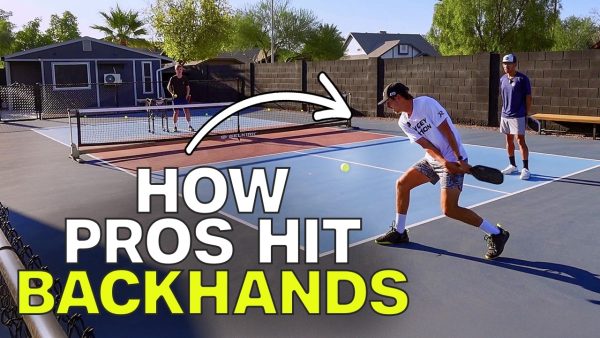
The fix is simple. When that ball is coming toward your left foot, step back. Create space. That one move turns your shoulder naturally, gets your contact point out in front of you, and lets you hit the ball at the top of the bounce where you actually have options.
Lock Your Wrist and Take the Extra Movement Out
This one shows up in almost every player I work with at the recreational and intermediate level. The wrist is moving too much during the stroke.
I get why it happens. When the ball gets behind you or you feel rushed, the wrist takes over trying to save the shot. But a wristy backhand is an inconsistent backhand. The ball pops up, it floats, it goes where you don’t want it to go.
What you want instead is a cocked, stable wrist from your backswing all the way through your follow through. Think about making a fist and then gripping your paddle. That firm, locked position is what you’re looking for.
Watch any high level player hitting a backhand dink or a third shot drop and the wrist barely moves. It’s the shoulder doing the work, not the hand.
Lock that wrist down and you’ll be amazed at how much cleaner the ball comes off your paddle.
Start Swinging from Your Shoulder, Not Your Elbow
Once the wrist is stable, the next thing to look at is where your swing is being generated from. And this is where a lot of players are making it harder than it needs to be.
I see players hinging from the elbow constantly. They pull the elbow back, get into this crowded position, and then try to swing through from there. It’s inconsistent because there are too many moving parts. Too many variables that can go wrong on any given ball.
The swing needs to come from your shoulder. Your elbow stays slightly bent but stable, your wrist stays locked, and the shoulder does the hinging. That’s how the top players generate such clean, repeatable contact. It’s a bigger, more reliable muscle group. Less that can go wrong. And when you make contact from the shoulder the ball just feels different, more controlled, more consistent.
Get to Your Contact Point Before the Ball Gets There
Even when players are doing a decent job with their wrist and their swing, a lot of them still struggle with contact point. Especially on crosscourt balls with heavy spin or pace that’s pulling them wide.
The goal is to move your feet early enough so that contact happens roughly between your knees. In front of your body. In a zone where you can actually swing from your shoulder with time to spare. That requires shuffling, staying low, and committing to the footwork before the ball gets to you. When you get there, the stroke takes care of itself.
Final Say: Stop Giving Up the Kitchen Line — Volley More Balls
Here’s something that quietly keeps a lot of players stuck on defense at the kitchen line.
They let every ball bounce when they should be taking some of them out of the air.
If your default mindset is always to shuffle back and let the ball drop, your opponent is going to push you off the line on every exchange. You’ll spend the whole rally getting pinned back further and further with less and less control over the point.
The better approach is to volley first whenever you can. If the ball is at a height where you can lean in slightly and take it cleanly out of the air while staying balanced, do it. Stay low, keep your wrist and elbow stable, and use that little lift from the shoulder we talked about. Taking the ball out of the air keeps you in a strong position and takes time away from your opponent.
Now, when the ball is really low, below the knee, that’s when you move your feet and let it bounce so you can get a proper contact point. But that should be the exception, not your default.
Your backhand doesn’t have to be a liability. Work through each of these pieces one at a time. Create your spacing first. Lock the wrist. Swing from the shoulder. Move your feet to your contact point. And start thinking about volleying more.
Do those things consistently and you’ll feel the difference faster than you expect.
See you on the courts,
Coach Jordan Briones