Hey there, it’s your coach Jordan Briones.
I want to be real with you for a second.
Most of the points you’re losing right now are not because your opponent is better than you. A lot of them are because of habits you’ve built without realizing it. Habits that feel totally natural in the moment but are quietly costing you game after game.
Here are the ones I see most often and exactly what to do instead.
7 Costly Pickleball Habits That Are Secretly Losing You Points
1. Stop Letting Your Forehand Hurt Your Defense
When an opponent starts attacking and the ball comes flying at your body, what do you do? If you’re like most players, you swing your forehand over to block it. It feels instinctive. It feels protective.
But here’s the problem. When you cross over to your forehand in that moment, your paddle face naturally opens up. And an open paddle face under pressure means the ball floats up right into a spot your opponent loves to attack. You’ve essentially handed them the next ball on a plate.
The better habit is learning to defend your body with your backhand. From a solid backhand ready position you can cover your chest, your waist, and even out past your right hip with a closed, controlled paddle face. It takes time to get comfortable there but once it clicks, your defense in fast exchanges becomes a completely different story.
2. Quit Attacking Balls That Are Below Your Knees
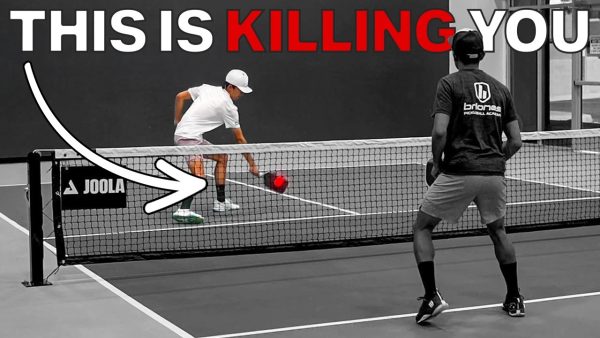
Getting a ball below your knees and trying to attack it anyway is one of those habits that feels aggressive in the moment but works against you more often than not.
When contact is that low, you are physically swinging upward to get the ball over the net. That upward trajectory gives your opponents time to read it and puts them in a great position to swing down at your feet on the very next ball. You’ve created a problem for yourself instead of solving one.
The smarter play when the ball is below your knees is to dink it. Keep it low, keep it unattackable, and be patient. Wait for a ball that sits up a little and gives you a real opportunity. That is the shot worth attacking on.
3. Start Taking Responsibility for the Middle of the Court
A lot of players think their only job is to manage whatever comes directly at them. But when the ball is crosscourt from you, you actually have a responsibility that goes beyond your own position.
You are covering the middle.
The fastest and most dangerous attack from a crosscourt dink is the speed up straight down the middle. If you are not shading toward the center line after hitting a crosscourt ball, that attack will catch you flat footed every time. Your partner simply cannot cover everything on their own.
Get into the habit of shuffling toward the middle right after your crosscourt shot lands. It’s a small movement but it puts you in position to intercept the most likely counter and take some pressure off your partner at the same time.
4. Use High Balls to Move Your Opponent, Not Hit at Their Chest
You work hard to get into position, you finally get a ball sitting up above the net, and then you unload it as fast and hard as you can right at your opponent’s torso.
At 4.0 and above this almost never works. Players at that level have a solid ready position and they block and counter chest-high balls consistently. When you attack there you are feeding them something comfortable.
Use that high ball to make them move. Go down at the feet. Pull them wide to a dominant or non-dominant side. The goal on that first attack is not to end the point with power. It is to get a ball that sets you up for the real put-away on the very next shot.
5. Create Space Instead of Reaching for Low Third Shot Drops
This situation trips up so many players. The ball is dipping low toward the kitchen line and the instinct is to reach in and volley it before it bounces. Sometimes that is absolutely the right call. But a lot of the time players reach when they should be creating space and end up hitting a weak half volley from an off-balance position.
If you cannot comfortably take that ball out of the air, move your feet. Step your back foot away from the line on the backhand side. Step your right foot back on the forehand side. Or use an angled shuffle step to create even more room while staying balanced and ready.
The extra space lets the ball rise to its natural apex where you can actually do something with it. It also gives you a split second to look up and pick a smarter target while your opponents are still moving into the court.
6. Slow Your Swing Down to Fix Floating Dinks and Drops
If your soft shots are consistently landing too long or floating up to get attacked, I want you to think about one thing: how fast are you swinging? Many players don’t realize that this small detail can make a huge difference, and understanding common pickleball mistakes and how to fix them often starts with noticing things like swing speed.
Most players in this situation are swinging too hard and they do not even realize it. With the same backswing and the same follow-through, a slightly faster swing will send the ball noticeably further. On shots where distance control is everything, that extra swing speed is the difference between a perfect drop and a ball that sits up waiting to be punished.
Go out with a partner and practice your dinks, drops, and resets by swinging as slowly as you possibly can. If the ball hits the net, add just a touch more speed or extend your follow-through slightly. The idea is to train yourself to feel the difference between a swing that controls distance and one that loses it. Start slow and work up from there.
7. Move Your Feet So You Stay Inside Your Strike Zone
Your strike zone is the area in front of your body, roughly between your hips. When you make contact there you have the most control, the most options, and the cleanest feel on the ball.
Every inch that contact moves outside that zone, whether you are reaching wide on the backhand or stretching out on the forehand, you lose a little more control. And in a game where margins are everything, those losses add up fast.
This is exactly why footwork matters so much. Moving your feet early so that you arrive at the ball rather than reaching for it is what keeps your contact point where it needs to be. It is a discipline that has to be practiced deliberately but the payoff shows up in every single shot you hit.
Final Thoughts
Take one of these, work on it this week, and watch what changes. You don’t have to fix everything at once. But picking one habit to clean up and staying focused on it is how real improvement actually happens.
See you on the courts,
Coach Jordan Briones