Hey there, it’s your coach Jordan Briones.
If you are new to pickleball, first of all, welcome. This game is incredible, and I am glad you found it — a great starting point to learn pickleball fundamentals for beginners.
But I want to be straight with you right away. There are three mistakes I see new players make almost universally. And the problem is not just that these mistakes hurt you right now — it is that they build habits that become really hard to undo the longer you practice them.
The earlier you catch these, the faster you will grow. Let’s get into it.
Mistake #1: Using the Bowling Motion Serve That Will Cap Your Ceiling
The serve starts every single point. So how you serve matters a lot — not just today, but as your game develops.
The most common serve mistake I see from newer players is what I call the bowling motion. The paddle goes straight back with no bend in the elbow, and the player just pushes it forward like rolling a bowling ball down a lane. Sometimes this comes from being taught that way. Sometimes it just gets copied from someone else on the court.
Here is the problem. That motion has a ceiling.
Can it be consistent for some players? Sure, in the short term. But it makes it almost impossible to generate topspin. And it does not translate to any of the other shots you are going to learn — drives, speed-ups, aggressive volleys. All of those require a completely different swing path. So if you build your whole game on a bowling motion, you are going to have to unlearn it at some point anyway.
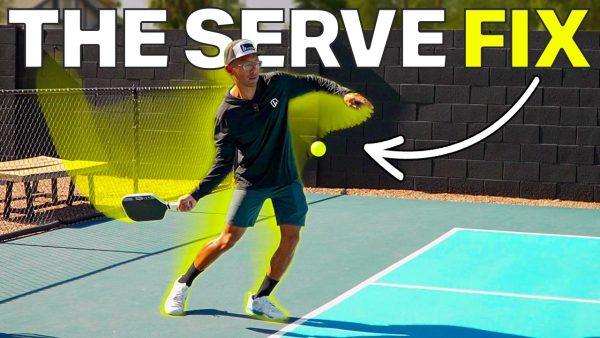
What you want instead is a real foundational swing. As a right-handed player, take your paddle back with a bend in your elbow, and make contact slightly out in front and a little to the right side of your body. That contact position is what allows you to swing low to high and generate topspin. Your follow-through should come up and around naturally toward your shoulder, not just push straight forward and stop.
This applies whether you are using a volley serve or a drop serve. The mechanics are the same. Get the contact point right, let the follow-through happen naturally, and you are building a serve that has real room to grow — a key part of pickleball serving technique for beginners.
It might feel awkward at first, especially if you are used to the bowling motion. That is normal. Push through it. The correct technique will pay off faster than you think.
Mistake #2: Using a Ready Position That Leaves Half the Court Unprotected
Your ready position at the kitchen line is how you prepare to handle everything your opponent throws at you. And most beginners get this wrong in one of four ways.
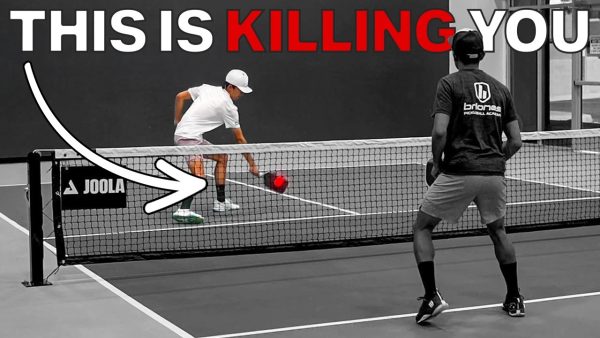
The first is holding the paddle too low — down near the waist or thighs. Anything coming at your chest or body is going to be very difficult to handle from that position. You have to lift the paddle a long way before you can counter, and in fast exchanges, you simply do not have that time.
The second is the opposite — holding the paddle out in front with a fully extended elbow. It looks ready, but the moment a fast ball comes at you, you have to pull your elbow in and then extend out again to counter. That extra movement is too slow.
The third is the extreme backhand position — paddle sitting on the backhand side covering the body. This might feel safe for balls coming at the chest, but anything coming to the forehand side requires a huge adjustment that most players cannot make in time.
The fourth is the extreme forehand position — the mirror image of the above. Great for forehands, but slow and late on the backhand side.
What the best players use is a neutral ready position. Paddle sitting roughly in front of the belly button, elbow slightly bent with about a foot to a foot and a half of space between the paddle and the body. Not too high, not too low, not favoring either side.
From that position, you can get to a body ball, reach your backhand with a simple turn, and open up to your forehand with a compact volley without repositioning your whole arm — mastering this helps you avoid some of the biggest pickleball mistakes for beginners and keeps your coverage efficient.
One more thing — the grip matters here too. At the non-volley zone line, most players do well with a continental grip, which is basically the same as gripping a hammer. It gives you the flexibility to handle both forehand and backhand volleys without needing to switch grips in the middle of a fast exchange.
Mistake #3: Drilling Dinks and Drops When You Should Be Mastering the First Four Shots
This one surprises people, but I see it all the time.
A beginner player reads or hears that dinking and third shot drops are critical in pickleball. And they are right — at the right level, those shots are absolutely essential. So they go out and spend most of their practice time working on dinks and drops.
The problem is that at the beginner level, rallies do not last long enough for those shots to matter most of the time. Points end early. Serves get missed. Returns go out. Third shots drive into the net. The game is won and lost in the first four shots — so that is exactly where your practice time should go.
Here is what I recommend building in order.
Start with the serve. Not just getting it in, but learning to put real depth and a bit of pace or topspin on it. A deep serve with some pressure gives your opponent a harder return to work with, which sets up the rest of the point in your favor.
Next, the return. This is arguably the most important shot for the returning team. A missed return or a weak floaty return gives the serving team a free aggressive third shot. You want a return that is deep, consistent, and gives you enough time to get up to the kitchen line.
After that, focus on the third shot drive — not the drop. I know that might feel counterintuitive, but the third shot drop requires a lot of precision and feel that takes real time to develop. Learning a solid drive first keeps the ball in play, puts your opponents in a decision-making moment, and buys you and your partner time to move forward together.
Finally, practice your counter volleys. When you are up at the kitchen line and your opponent drives the third or fifth shot at you, your ability to handle that pace and redirect it determines whether you stay in the point or give up an easy winner. Counter volleys are going to come up constantly, and most beginners are completely unprepared for them.
Serve, return, drive, counter volley — master those four first. Doing so helps you avoid some of the biggest pickleball mistakes for beginners. The dinks and drops will come, and when they do, they will be built on a much stronger foundation.
Final Thoughts
These three mistakes are not about talent. They are about direction. And you now know which direction to go.
Fix your serve motion before the bowling habit locks in. Find your neutral ready position so you are never caught flat-footed at the kitchen. And spend your practice time on the shots that will actually decide your points right now.
The players who improve the fastest are not the ones who practice the most. They are the ones who practice the right things from day one.
Go get your reps in. You’re already ahead of where most people start.
See you on the courts,
Coach Jordan Briones