Hey there, it’s your coach Jordan Briones.
There’s a shot making the rounds right now that I cannot go a week without someone asking me about.
The shovel drop.
You’ve probably seen it. Ben Johns uses it. JW Johnson uses it. It looks effortless in their hands and it is starting to pop up everywhere at every level of play. And I get it — when the best player in the world pulls off a shot, everyone wants to add it to their game.
But here’s what I want you to hear before you run out and start drilling it. Understanding what this shot actually is, when it is meant to be used, and whether it is right for your game right now is going to save you a lot of frustration.
Let’s break it down.
What the Shovel Drop Actually Is and When It Shows Up in a Rally
The shovel drop is not a shot you set up for. It is a shot that happens to you.
Here is the scenario. You have just hit a solid third shot drop or a drive and you are making your way through the transition zone toward the kitchen. Your opponent counters well and now you have a ball that is bouncing low — right at your back foot or even slightly behind you as you are moving forward.
That is the moment the shovel drop exists for. It is a reactive, improvisational shot for a ball that has gotten behind your ideal contact zone.
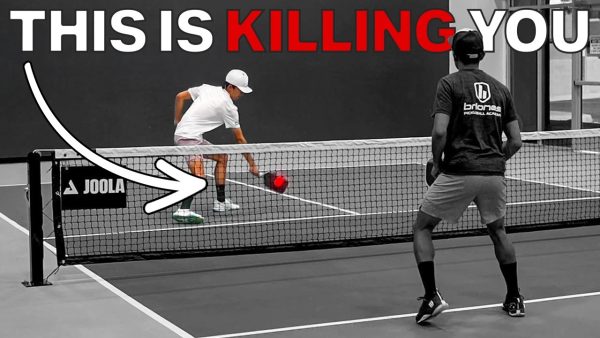
The contact point on this shot is different from almost everything else you practice. Instead of getting the ball out in front of your body — which is the goal on nearly every other shot — the shovel drop has you making contact at your back leg or even slightly past it. The paddle head drops low to get under the ball, and your body momentum moving forward actually helps generate the lift needed to get the ball up and over the net.
Grip pressure should stay light throughout. And the further that contact point gets behind you, the less control you have. There is a limit to how far back this shot can work before it starts breaking down.
The Pros: Execute the Shovel Drop and What They Adjust Based on Ball Height
The mechanics of the shovel drop shift depending on where the ball is when you get to it.
If the ball is sitting a bit higher and landing near your back leg, you can keep your paddle head relatively upright on the side of your body as you make contact. But if the ball is lower or dropping fast, you need to get the paddle head down lower as well — almost scooping under the ball — to generate enough lift to clear the net.
Think of it as two versions of the same shot. Slightly higher ball, more of a side-paddle orientation. Lower ball, more of a true scoop with the paddle head angled down. Either way, the momentum of your back foot pushing you forward into the shot is what gives the ball its energy. You are not swinging hard. You are using your body’s natural forward movement as the power source.
Players like Ben Johns have made this shot look routine because their footwork, timing, and feel are at an elite level. They can pull it off consistently because everything leading up to that contact moment — their balance, their court position, their preparation — is dialed in. The shot itself is just the final piece of a well-constructed rally.
The Cons: Why the Shovel Drop Comes With Real Risks You Need to Understand
Here is where I want to be honest with you, because this is the part most people skip over when they see a cool shot on social media.
The shovel drop is inherently a lower-percentage shot. The contact point being behind or beside your body instead of in front of it means you have less vision of the ball, less control over your swing path, and less ability to read the court as you are hitting.
And that last part matters more than most players realize. When your contact is out in front, you can see the ball clearly and you can also see your opponent’s positioning at the same time. You have information. When the ball is at your back leg and your body is twisted or reaching behind, that picture goes away. You are essentially hitting blind.
On top of that, this shot does not set you up for an aggressive follow-up. When you scoop a ball from behind your body, you are limited in what you can do next. The natural shot after a shovel drop tends to be a softer, more conservative reply — which is fine for survival, but it means you are not putting real pressure on your opponent with that shot.
Compare that to hitting the ball out in front with topspin on your fifth shot drop. You get control, visibility, and the ability to dip the ball at your opponent’s feet as you continue moving forward. That is a much more complete play.
Who Should and Should Not Be Practicing the Shovel Drop Right Now
I want to be straightforward here because I think this is where a lot of players go wrong.
If you are below the 4.0 level, I would not be spending practice time on the shovel drop. At that stage of development, the single most important habit you can build is getting your contact point out in front of your body on every shot. That principle — contact in front, vision on the ball, full control — is the foundation of every reliable shot in this game.
The shovel drop is the exception to that rule. It exists for emergency situations where you cannot get to the ball in time to set up properly. If you practice the exception before you have the rule down, you start normalizing late contact. And that is a habit that is genuinely hard to fix later.
Now, if you are playing at a high level — 4.5, 5.0, tournament-level play — and you want to add this to your toolkit as a bail-out option for balls that get past your transition zone, that is a different conversation. At that level, you already have the fundamentals locked in. Adding a creative emergency shot makes sense because you know when to use it and when not to.
The mistake is treating the shovel drop like a primary weapon instead of a last resort.
What to Work on Instead If You Want a Better Drop in Transition
If you are trying to improve your drop game through the transition zone — and you absolutely should be — here is where to put your energy.
Focus on getting to the ball early. Most of the situations where the shovel drop seems necessary happen because the player was slow to react or slow to move, and now the ball has gotten behind them. Better footwork and faster recognition of where the ball is going solves this before the problem even starts.
Work on your topspin fifth shot drop with contact in front. This is the shot that gives you everything — control, vision, the ability to dip the ball, and a swing that sets you up to keep moving forward toward the kitchen. It is a harder shot to learn than the shovel drop. But it is the right shot to build your game around.
And when a ball genuinely does get behind you and the shovel drop is the only option? Use it. That’s what it’s there for. Just do not go looking for it or practice it as a go-to technique before you have your fundamentals in order.
Final Thoughts
The shovel drop is real, it is effective at the right level, and the pros use it for a reason. I am not telling you to ignore it forever.
What I am telling you is this: understand what the shot actually is before you start chasing it. It is a reactive emergency option for a specific type of ball in a specific situation. It is not a new way to drop. It is not a replacement for solid transition fundamentals.
Build the foundation first. Get your contact out in front. Get comfortable in the transition zone with a proper fifth shot drop. And when the moment comes where a ball genuinely gets behind you and you need a creative answer — you will have the shovel drop ready and you will actually know how to use it.
That is how you add shots to your game the right way.
See you on the courts,
Coach Jordan Briones