Hey there, it’s your coach Jordan Briones.
Every player makes errors. Even the best in the world miss shots. That is just part of the game and it always will be.
But there is a real difference between a physical error and a mental mistake. A physical error is when your technique breaks down — you misjudge the ball, your footwork is late, your swing is off. Those happen. You work on them and they get better.
A mental mistake is different. It is when you had a better option available and you chose the wrong one. It is when your decision in the moment cost you the point, not your skill.
The frustrating part about mental mistakes is that you often do not even realize you are making them. They just feel like bad luck or bad shots. But they are not. They are patterns. And once you see the pattern, you can fix it.
The 3 Mental Mistakes Costing You Points in Pickleball
Here are the three mental mistakes I see costing players points in almost every single game.
Mental Mistake #1: Trying to Out-Angle Your Opponent When You’re Already Off Balance
Picture this. You are in a crosscourt dink battle. Your opponent puts a nice angled dink on you with some topspin, pulling you wide toward your sideline. You are stretched out, your weight is moving left, and you are working hard just to get your paddle on the ball.
And then — for some reason — you try to rip an extreme angle right back at them.
I see this constantly. And I understand why it happens. There is something in a competitive player’s brain that says, you hit a tough shot at me so I need to hit an even tougher shot back. It feels like the right competitive response.
But here is the reality. When you are off the court, off balance, and reaching to make contact, you are in the worst possible position to execute a precise, low-percentage angle. The outcome is almost always one of three things: the ball clips the net, it sails wide, or you pop it up and hand your opponent a smash.
And even if you do pull it off, now you and your partner have to cover a massive amount of court to recover into position — another example of the subtle mental mistakes in pickleball that cost points over time.
The fix is discipline. When your opponent pulls you wide and puts you in a tough spot, that is the moment to stop trying to win the point right then and there. Hit the ball toward the middle of the court. Middle is safe. Middle buys you time. Middle lets you recover and get back into position alongside your partner.
You will win far more points by staying in the rally and waiting for a better look than by forcing a hero shot from the worst possible position on the court.
Mental Mistake #2: Forcing Attacks from Positions Where You Can’t Actually Win the Exchange
This game is getting more aggressive. I know that. And I encourage players to develop their attacking game. But there is a version of aggression that hurts you, and it comes from forcing attacks before the setup is actually there.
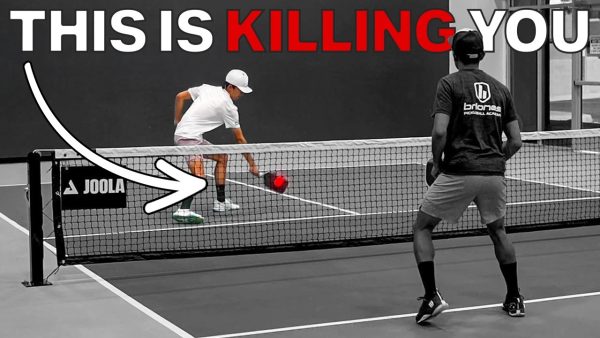
Here’s the first version I see. A player is right up at the non-volley zone line and they take a ball out of the air — but their contact is at or below knee level. They decide to speed it up anyway. The problem is that from that contact height, the ball has to travel in a sharply upward trajectory to clear the net. That means their opponent is getting a ball coming up at them, not down at them. It is easy to counter. And that counter is almost certainly going to come right back down at their feet with pace.
The second version happens when a player is getting pushed around by tough dinks at the kitchen line. The dinks are landing near their feet, pushing them back or off balance. Instead of resetting and regaining position, they try to force a speed-up from that awkward, uncomfortable spot. Even if the speed-up goes in, they are already out of position for the counter that is coming right back.
Both situations have the same root cause. The player wants to attack, so they attack. Even when the situation is telling them not to.
The smarter play in both cases is patience. One of the most common mental mistakes in pickleball is forcing an attack when the ball is below knee level. If you are taking the ball out of the air but it is that low, do not speed it up — just dink it back. Regroup. Get your balance. Get your contact point up. Wait for a ball that is at a height where you can actually do damage with a speed-up.
If you are getting jammed at your feet, get that next ball to bounce in the non-volley zone. Let it land in front of your opponent. Buy yourself the second it takes to get back to a strong position at the line. Then look for your attack.
The best attackers in this game do not attack constantly. They attack selectively. And the patience to wait for the right moment is what makes those attacks land.
Mental Mistake #3: Demanding Perfection on the Third Shot Drop and Freezing Under That Pressure
The third of the common mental mistakes in pickleball is one that I think actually gets created by good intentions.
Players hear that the third shot drop is critical. They practice it. They know it has to land softly in the non-volley zone. And somewhere along the way, they develop this idea that every third shot drop has to be perfect — so low and so precise that their opponent at the kitchen line cannot possibly take it out of the air.
That standard is too high. And chasing it is costing them points.
When you put that much pressure on a single shot, you tighten up. Your swing gets short and jerky. You aim for the very edge of the kitchen and miss long or short. You start rushing the drop before you are in a good enough position to execute it. And the result is more inconsistency, not less.
Here is how the best players think about the third shot drop. They give themselves margin. They aim to land the ball with enough height over the net to be consistent, even if it means their opponent might volley it. Because here’s the thing — if your drop gets taken out of the air, you simply hold your ground. You do not rush in. You read the ball, stay back, and play the next shot.
The third shot drop is not supposed to be a winner. It is supposed to give you a chance to get to the kitchen. One ball at a time.
And if the drop is not working on a given day — or if you are getting a return with so much pace and topspin that a drop is genuinely hard to execute — use a drive instead. A low, aggressive drive can force a weak fourth shot volley, and now you have a much better look at your fifth shot drop from a position of control.
Stop demanding perfection from yourself on that shot. Give yourself margin. Play the percentages. That is what the pros do.
Final Thoughts: Fix the Mental Game and the Physical Game Becomes a Lot Easier
Technique matters. Footwork matters. Shot mechanics matter. But none of it gets you very far if the decision-making behind the shots is working against you.
Stop chasing extreme angles when you are already in trouble. Stop forcing attacks from positions where the odds are stacked against you. Stop demanding perfection on the third shot drop and let yourself play with some margin.
These are not complicated adjustments. They do not require you to hit harder or be more athletic. They just require you to think a little more clearly in the moments that matter.
Bring this awareness to your next session. Notice when one of those mental mistakes in pickleball is about to happen. Pause. Make the smarter choice.
You will be surprised how many points you start winning without changing a single thing about your technique.
See you on the courts,
Coach Jordan Briones