Hey there, it’s your coach Jordan Briones.
I recently had the chance to hit with MLP and PPA pro Mari Humberg, and I have to be honest with you — what she showed me completely shifted the way I think about one of the most overlooked parts of the game.
We’re not talking about the third shot today. We’re not talking about resets, drops, or how to transition in. We’re talking about the other side of that equation. We’re talking about what you should be doing when your opponent is the one stuck in transition.
And here’s the thing. There’s a ton of content out there about how to transition in. But almost nobody is talking about how to make that transition as painful as possible for the person coming in. Mari noticed it too, and once she broke it down for me, I realized this is something every player at every level needs to hear.
How to Turn Opponent Mistakes in Transition Into Pickleball Winning Points
Attack the Transition Zone to Dominate Points – Take Control
Let’s get something straight right away. You can only score points when you’re serving. That’s the rule of the game. So naturally, a lot of players pour their energy into thirds and fifths and grinding their way to the kitchen.
But here’s what Mari pointed out that really stuck with me. If she can hold you back from scoring — if she can make your transition shot feel like you’re walking through fire every single time — she’s creating more opportunities on her own serve. She’s controlling the rally without even being the one in trouble.
Most players let their opponents transition in peace. They float the ball back, give them a manageable reset, and wonder why they can’t close out points. That ends today.
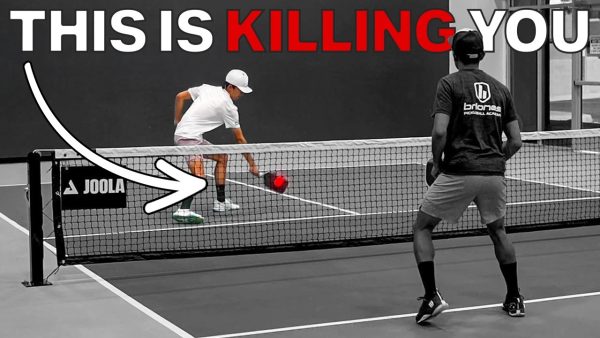
Take Advantage of High Balls: Hit Hard and Aim at Their Feet
Mari made this look effortless when we were drilling, and I’ll tell you right now, from the other side of the net it did not feel effortless at all.
When the ball is above the net and you’re in a position to take it out of the air, there’s really only one thing on your mind. Hit it hard. Don’t overthink it. Don’t try to get cute with placement. Just load up and drive it.
But here’s the one detail that separates a good hard shot from a great one. Don’t aim at their body. Aim right at their feet. Right in between the toes if you can.
Think about what that does to someone in mid-transition. They’re already uncomfortable. They’re moving forward, they’re low, and they’re trying to find a reset. Now you’re jamming them right at the ground. They can’t generate pace from that position. They can’t lift it comfortably. All they can do is try to survive.
If you’ve ever struggled generating power on that ball, Mari had a tip for that too. On the forehand side, use a little slap motion through contact to create more pop. It’s not a swing from the shoulder. It’s a quick, snappy acceleration through the ball. Try it next time you drill. You’ll be surprised how much pace you can generate without a big backswing.
Stop Ripping Low Balls: Use Spin to Jam Opponents in Transition
This is where most players get it wrong. And I mean really wrong.
When the ball drops below the net level and you’re at the kitchen, the instinct is to still try to rip it. I’ve done it. You’ve probably done it. But Mari was crystal clear on this one.
You cannot generate the same pace from a ball below the net that you can from one you’re putting away above it. It’s not about effort. It’s physics.
So instead of trying to force pace on a low ball, Mari switches gears entirely. She loads up heavy topspin. And when she executes it right, the ball kicks low, stays out of your reach when it bounces, and still finds your feet.
Here’s why that’s so effective. If she hits it high and slow, you can rush in and take it out of the air before it bounces. Easy reset. You’re back in control. But if she keeps it low with that heavy spin, now you have to deal with it off the bounce — and a spinning ball that dips into your feet off the bounce is one of the hardest things to reset cleanly in this game.
The goal isn’t pace. The goal is placement. Every time. High or low, the target is the same. Make them pick it up from the ground.
Where to Aim — and Why It Changes Based on the Shot
Mari broke this down in a way that really made sense to me, and it’s worth paying attention to.
On the high put-away ball, placement matters a little less. You have enough pace that even if you’re slightly off target, you’re still making life hard for your opponent. If anything, she’d rather hit it slightly behind them because resetting a fast ball out of the air is incredibly difficult with your weight moving forward.
But on the low spinning ball, she’s thinking completely differently. She actually aims a few feet in front of her opponent on purpose. She wants the ball to bounce before they can get to it. She does not want them taking it out of the air, because that’s a much easier reset to execute.
And here’s the extra detail — this is exactly how to put pressure on opponents in the transition zone. If they’re farther back, she adjusts deeper. If they’re closer in, she drops it shorter right in front of their feet. She’s always reading where they are and adjusting her target accordingly.
That kind of intentionality is what separates a player who hits good shots from a player who consistently wins points.
Make Every Transition Shot Feel Like It Has No Margin for Error
I’ll be real with you. I was the one transitioning in during this drill, and it was uncomfortable in the best way. Mari wasn’t doing anything that looked supernatural. She wasn’t crushing the ball out of control. She wasn’t making crazy low percentage plays.
She was just making me feel like every transition shot had to be perfect. Like there was no margin for error. Like if I gave her anything even slightly above the net, I was going to pay for it immediately.
That’s the whole point. When you apply pressure consistently from the kitchen line, your opponents don’t just struggle on that shot. They start second-guessing their third shot before they even hit it. They tighten up. They try too hard. And suddenly the points start coming your way without you having to do anything extraordinary.
Read the Ball Height: When to Drive and When to Add Spin
Here’s a simple way to think about all of this. Picture a sliding scale.
The higher the ball is above the net — the more you lean toward power.
The lower the ball drops below the net — the more you lean toward spin.
That’s it. That’s the framework. You’re not guessing. You’re reading the height of the ball and choosing your approach before you even swing.
Slice works too on those lower balls, by the way. If you get it down and toward their feet, it’s going to cause just as much trouble. The key is always the same. Keep it low. Make them lift it. Put them under pressure.
Final Thoughts – Make the Transition Zone a Nightmare
This is not about winning every single point when your opponent comes in. Mari said it herself. The goal is to make them feel pressure. To make them think twice before hitting a mediocre third shot. To put the idea in their head that if they don’t execute, they’re going to be in trouble.
When you do that consistently, something shifts. The whole dynamic of the match changes. You stop just reacting and start controlling.
Pick one thing from this and work on it this week. If the high balls are your weakness, drill that put-away with a partner. If you’ve never tried generating topspin on a low ball from the kitchen, spend ten minutes on the wall working on that brushing motion.
The transition zone is not just something to survive. It’s a place to do real damage.
See you on the courts,
Coach Jordan Briones