Hey there, it’s your coach Jordan Briones.
Your serve sets the tone for every single rally. A weak serve puts you on defense before the point even starts. A strong serve? It puts immediate pressure on your opponent and starts the point on your terms.
The best part is that getting significantly more power and consistency on your serve doesn’t require you to try harder. It actually requires you to do less. Let me show you what I mean.
How to Build a More Powerful and Consistent Pickleball Serve
Turn Your Hips and Shoulders Before You Start Your Swing
Before you even think about swinging, your setup needs to be right. Whether you serve with an open stance or a closed stance, the key is that your hips and shoulders start turned sideways, facing the side fence rather than the net.
This one positioning detail changes everything that comes after it. When your hips and shoulders are pre-turned, you create the conditions for a full, free swing through the ball. Your arm isn’t doing all the work. Your whole body is ready to unwind into the shot.
Most players who struggle with a weak or inconsistent serve are set up square to the net from the start. They’ve already limited themselves before the swing begins.
Use Your Core as the Engine of Your Serve
Once you’re turned and set, the power in your serve comes from unwinding your core toward the target. This is what coaches mean when they talk about using your big muscles instead of just your arm.
In a closed stance, your hips naturally face sideways and then rotate forward as you swing through. In an open stance, same thing. Your core starts coiled and then releases toward the ball as you strike. That rotation is where the real force comes from.
When you do this correctly, the swing feels almost effortless. You’re not muscling the ball. You’re letting your body rotate and your arm follow. Players who try to generate pace with their arm alone are working twice as hard for half the result.
Loosen Your Grip and Let the Paddle Work for You
This one surprises almost everyone I work with.
When serving hard, most players grip the paddle tighter thinking that more grip equals more control and power. The opposite is actually true. Every top pro player, even when they are going after a big serve, holds the paddle with a fairly loose grip. Think of it as a three or four out of ten on grip pressure. For players looking to learn how to improve your pickleball serve, mastering this relaxed grip is one of the most important fundamentals.
Here is why this matters. A loose grip allows something called wrist lag or paddle lag to happen naturally as your arm accelerates through the swing. Your wrist and paddle trail slightly behind the motion of your arm, and when they snap through at contact that lag creates a whipping effect that adds significant pace to the ball.
The key is that you do not manufacture this. You do not try to flick your wrist. You simply keep your grip relaxed and rotate your core aggressively. The lag develops on its own as a result of the swing speed. Try to force it and it falls apart.
Make Contact in Front of Your Body for Maximum Power
Even with good rotation and a loose grip, a late contact point will kill your serve. And this is one of the most common problems I see.
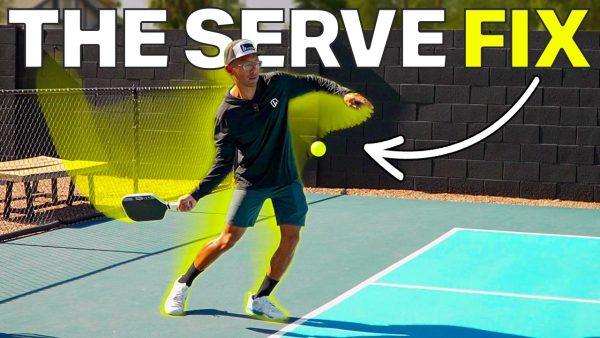
For maximum power and consistency, contact needs to happen just outside your front knee line, slightly in front of your body. When you make contact there your arm is in the strongest position to swing through freely and your body weight can move into the ball naturally.
The most common fix is simply changing where you release or toss the ball. A lot of players drop the ball too close to their body or slightly behind them and then the contact ends up late. Extend your front arm out as you release and make sure the ball is dropping into a spot that keeps your contact point in front of you.
Check Your Follow Through to Know if Your Swing Was Correct
Watch any professional player serve and pay attention to where their paddle finishes. Every single one of them, men and women, open stance and closed stance, finishes high above their opposite shoulder.
That is not a stylistic choice. It is the natural result of a correct swing path.
A proper serve swing starts low, gets underneath the ball, and travels up and around the body. When that happens, the paddle naturally ends up high over the left shoulder at the finish. If your follow through is ending out in front of you or dropping low, your swing path is going the wrong direction and you are leaving power on the table.
Work on swinging up and around your body rather than straight out toward the net and let that high finish happen naturally.
Let Your Weight Shift Forward Instead of Holding Back
On a closed stance serve especially, you will notice that the best servers let their back foot come forward into the court after they strike the ball. Players like Ben Johns do this consistently and it is not something they are thinking about.
Your weight naturally moves forward as you uncoil through the serve. Letting that momentum carry your foot into the court actually serves two purposes. It puts more forward weight into the shot which adds power, and it catches your body so you don’t fall forward.
A lot of players resist this or try to keep their feet planted and what ends up happening is they hold back on the swing to stay balanced. Let the weight shift happen. It is not a flaw in your technique. It is evidence that your body is moving through the ball the way it should.
Final Say
Here is the thing about the serve that most players overlook. Everything you are working on in your serve, the rotation, the wrist lag, the swing path, is directly connected to your drive. The mechanics are nearly identical. So when you put time into improving your serve, you are quietly improving one of the most important offensive weapons in your game at the same time.
Go work on one piece at a time. Start with your setup and rotation. Get comfortable with that and then layer in the grip pressure and contact point. The power will come, and it will feel a whole lot easier than what you have been doing.
See you on the courts,
Coach Jordan Briones